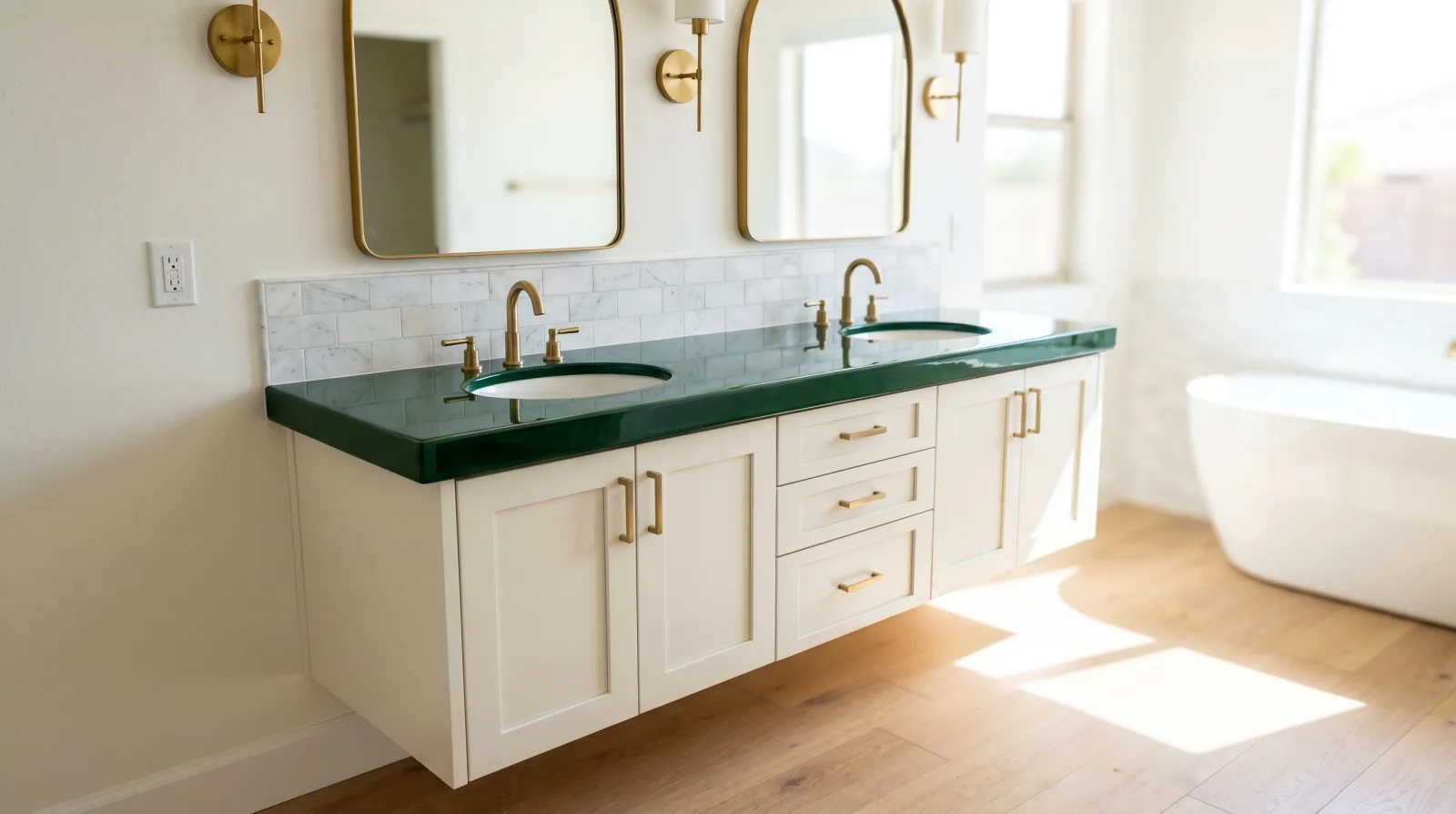
Pure Forest Green Vanity + Cream Cabinets
Solid forest green epoxy — deep, rich, saturated, hyper-glossy — over warm cream painted shaker vanity cabinets. Brushed brass faucets and hardware. Two ar
The look
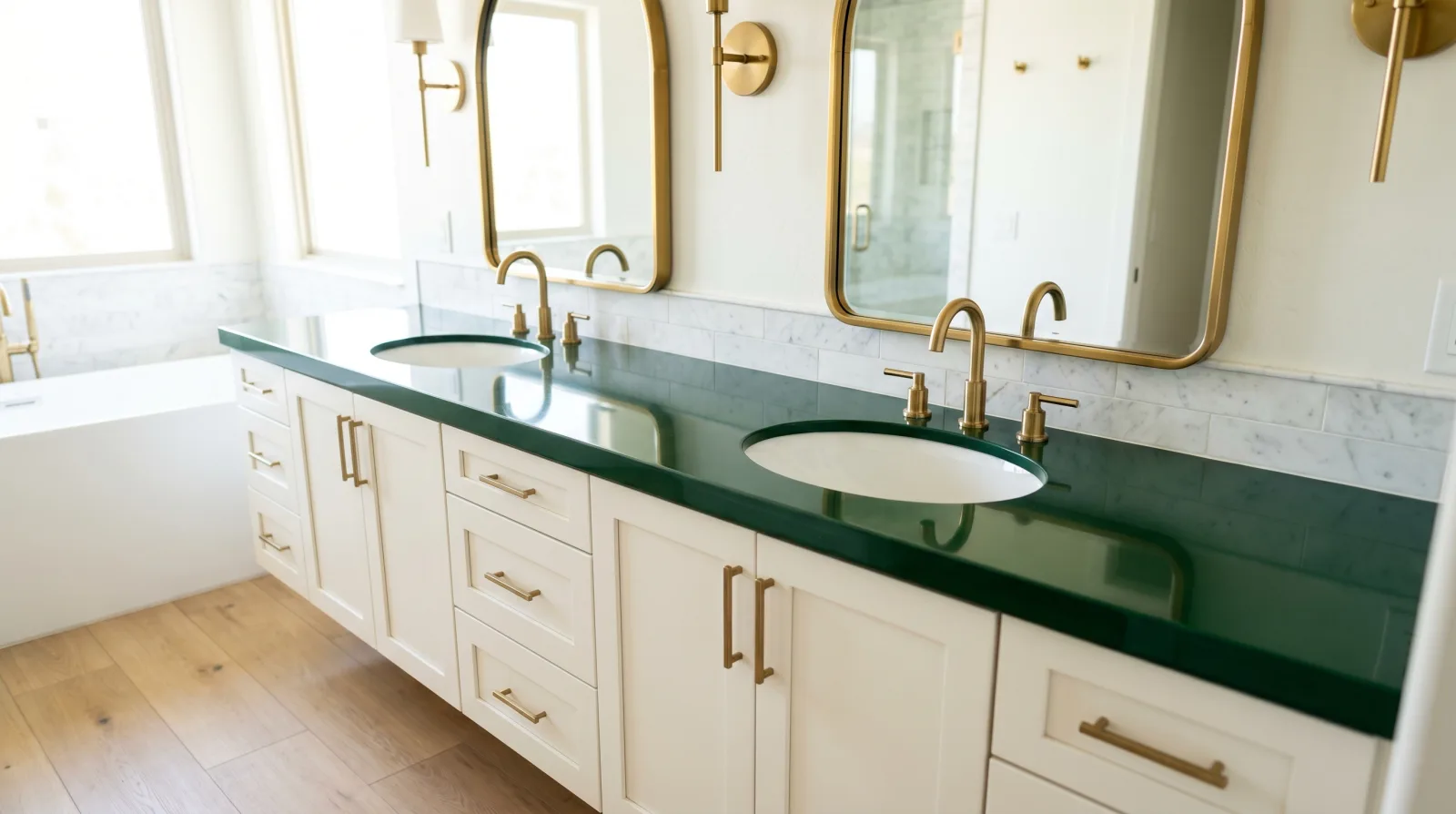
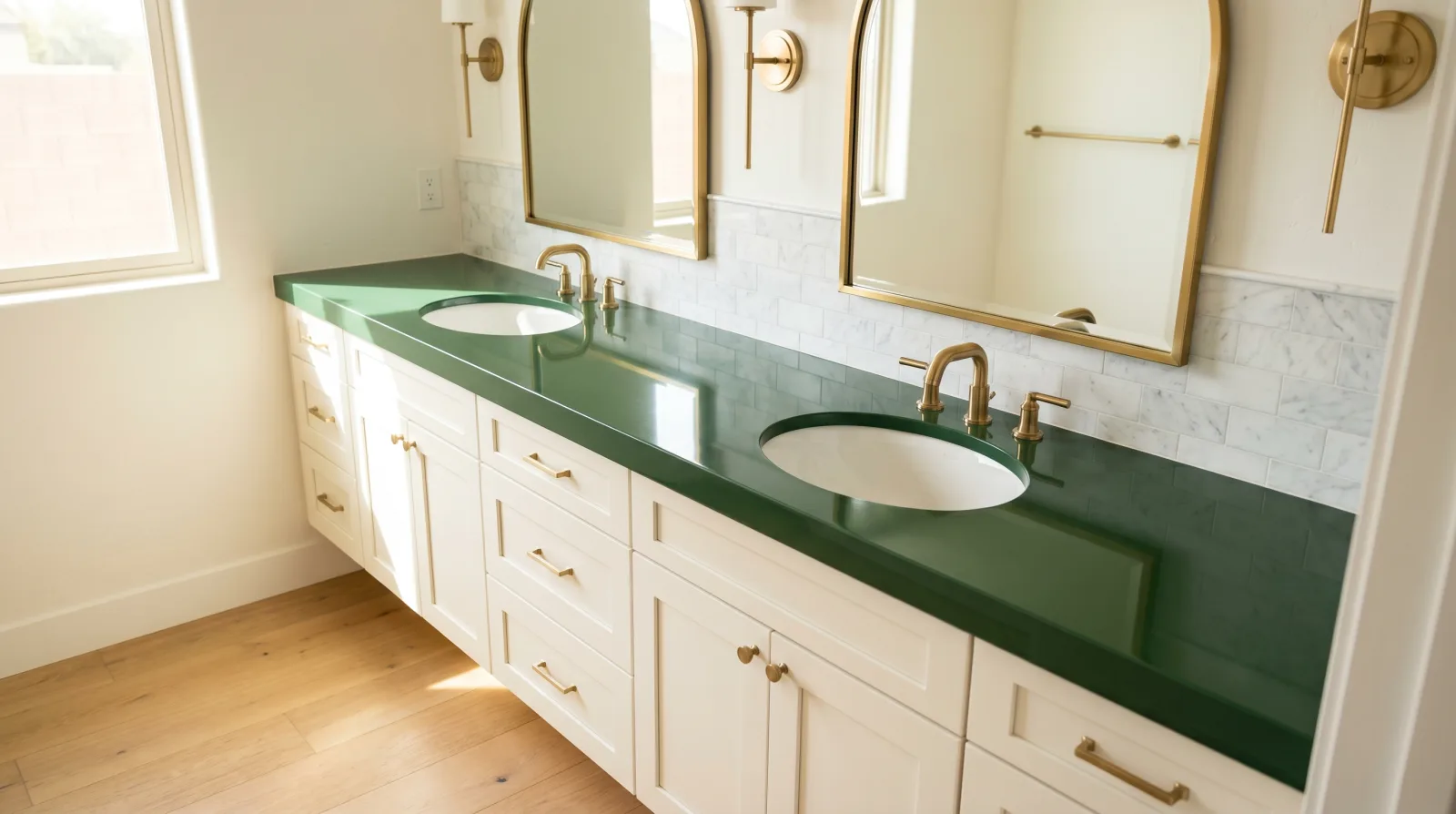
Solid forest green epoxy — deep, rich, saturated, hyper-glossy — over warm cream painted shaker vanity cabinets. Brushed brass faucets and hardware. Two arched brass-framed mirrors. White marble subway tile backsplash. Light oak floors. The combination is timeless-meets-distinctive. Not boring, not faddy.
Why it works in Glendale
Glendale's the largest West Valley city and its design taste skews family-warm rather than Scottsdale-cold. Forest green hits warm without going beige. It pairs with cream cabinets that most Glendale homes already have. And it photographs uniquely — almost nobody else's listing photos have a green counter, which means yours stand out in the MLS scroll. In a market where Glendale single-family inventory has been turning over in 45–60 days, listing photos matter directly.
The catch
Pigmented quartz in forest green runs $90–140/sqft installed. A typical Glendale master vanity — 60–72 inches — runs $1,800–$3,500 for the counter alone.
How we do it for $299
Build-A-Counter pours pure forest green lab stone over your existing vanity counter in 8 hours. Solid pigment, no veining, hyper-glossy mirror finish. Bonds permanently. Heat- and stain-resistant. Plumbing stays connected. Harder than the surface underneath.
The vanity above? $299.
Dark counters and Glendale water
Here is the thing nobody mentions when they sell you a dark vanity top: in the Valley, dark surfaces show water. Phoenix-area municipal water is hard — typically in the 12 to 20 grains per gallon range depending on the season and the blend of Salt River and Colorado River supply reaching your part of town. Every drop that dries on a counter leaves behind the dissolved calcium and magnesium it was carrying. On a cream or beige top you will never notice. On forest green, every one of those spots is a small white ring.
This is the single most common regret we hear from homeowners who went dark on a bathroom counter. It is also entirely a surface-porosity problem, not a colour problem. A porous or lightly-sealed surface lets mineral deposits key into microscopic pits, and once they are in there, wiping does not remove them — you need an acid, and acid is exactly what etches natural stone. That is the trap: the cleaner that removes the spot damages the counter.
Lab stone sidesteps it because the cured topcoat is non-porous. Minerals dry on the surface with nothing to grip, so they lift with a dry microfibre cloth or plain water. No descaler, no vinegar, no polish. A dark lab stone vanity in a Glendale bathroom stays dark instead of slowly going cloudy over two summers.
What is probably under your Glendale vanity right now
Glendale's housing stock skews to single-storey ranch and stucco builds from the 1970s through the 1990s, concentrated around the 85301–85308 ZIPs. In bathrooms of that era the near-universal default is cultured marble — a cast polymer top with the sink moulded into it as one continuous piece, usually in white, cream, or a speckled almond.
Cultured marble is excellent news for resurfacing. It is dimensionally stable, it is already flat, and it takes a bond coat well. It is the easiest substrate we work over. The reason homeowners assume they need a full replacement is the integrated sink: because the bowl and the deck are one casting, replacing the top means replacing the bowl, which means pulling the faucet and breaking the drain connection, which is how a vanity job turns into a plumbing job.
We pour around the existing bowl and leave the plumbing connected. Your faucet does not come off. Your drain does not get disturbed. The bowl stays the colour it is — which is worth looking at honestly before you commit, because a bright-white moulded bowl against a forest green deck is a deliberate two-tone look, and some people love it and some people do not. We will show you where that line falls at the consultation.
Common questions — Glendale vanities
Will forest green make a small bathroom feel smaller?
Less than you would expect, because the finish is glossy. A matte dark surface absorbs light and
closes a room in; a high-gloss one reflects the vanity light back up and reads more like a mirror
than a mass. The rooms where dark counters genuinely struggle are windowless bathrooms with a
single dim overhead fixture — in that case the counter is not the problem, the lighting is.
Can you match the green to cabinets I have already painted?
Usually. Bring a door or a drawer front to the consultation, or leave one out on install day. Our
pure pigments are mixed rather than picked from a fixed chart, so matching an existing cabinet
colour is realistic. Matching a cabinet you are planning to paint is harder — do the
cabinets first, then the counter.
How long before I can use the sink?
Light use the same evening. The surface reaches full cure over the following days. The practical
restriction on night one is leaving anything wet sitting on it — a shampoo bottle, a damp towel —
not the water itself.
Do you work in the 85301 to 85308 area specifically?
Yes, all of them, and the surrounding West Valley — Peoria, Sun City, Surprise, Avondale, and
Litchfield Park. Glendale is a routine day trip for us, not a travel-surcharge job.
If you would rather see how the same pure-pigment finishes read in other rooms, the navy vanity in Peoria and the forest and cream kitchen in Cave Creek are the closest comparisons. For the full material breakdown, our guide to countertops in the Arizona climate covers how each surface behaves through a Phoenix summer.
Get This Look — From $299
8-hour install. No demolition. Glendale-area only.
Start My Free Quote Call (602) 507-2683

