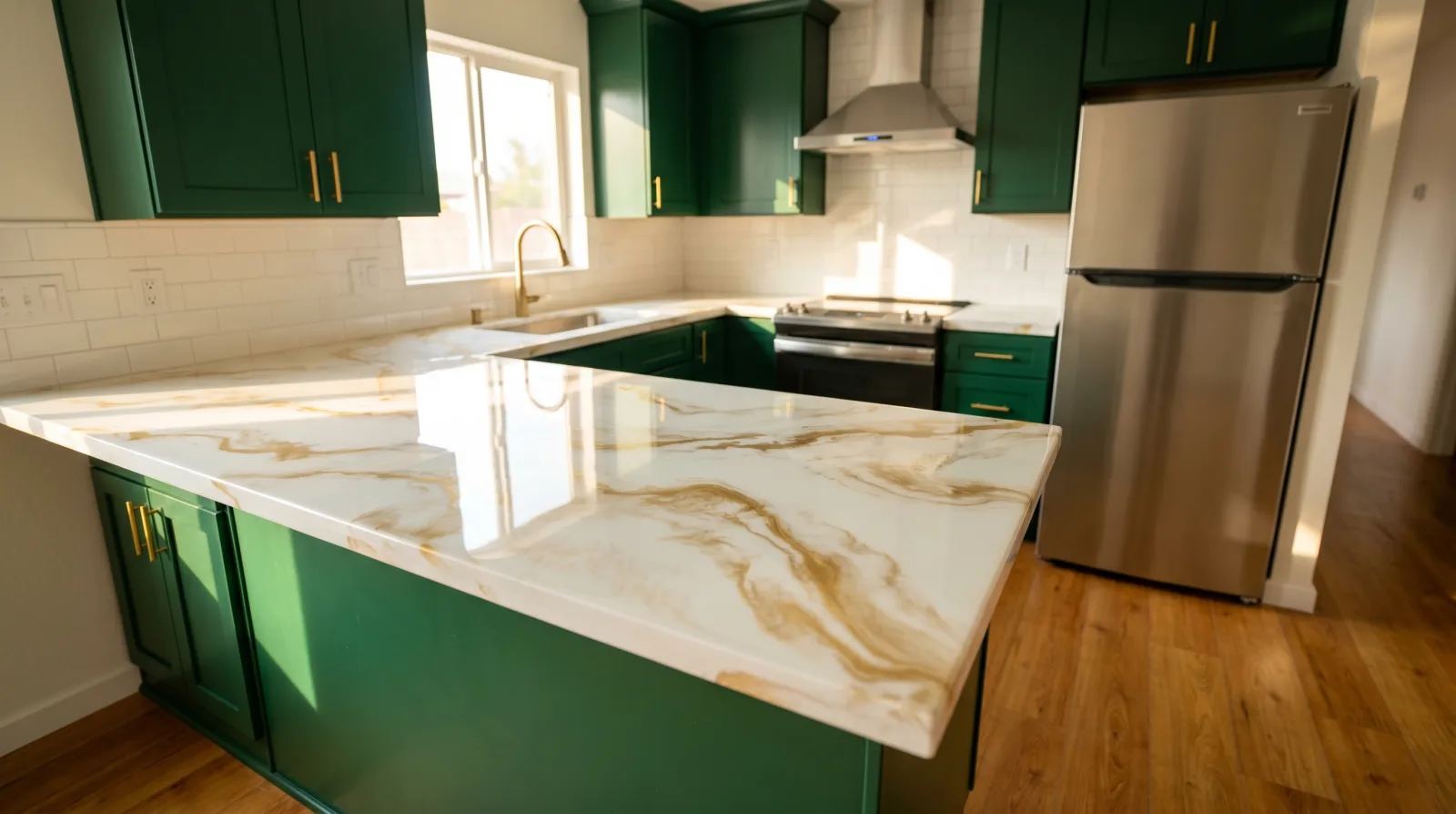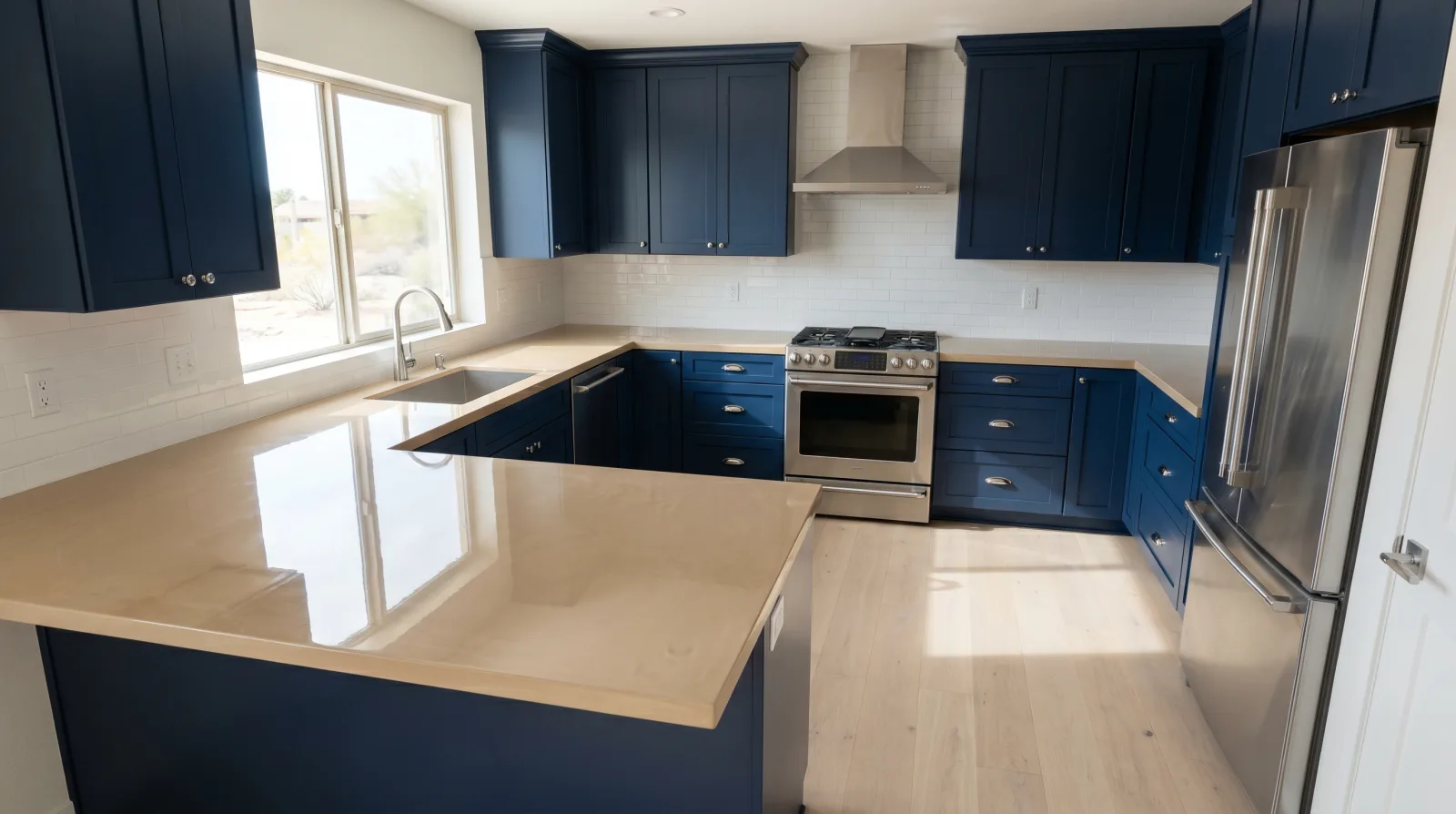
Choosing the best countertops for Arizona climate is a different decision than choosing countertops anywhere else in the country. You're not just picking a color or a finish — you're engineering against 115°F+ summer days, UV radiation that bleaches materials other states never have to worry about, monsoon humidity swings, and the thermal cycling that comes from a surface going from cold AC to a scorching direct-sun afternoon every single day for decades. Get it wrong, and your $6,000 slab is cracking, fading, or delaminating inside five years.
I've been in Phoenix metro kitchens from Fountain Hills to Surprise, Tempe to Carefree, and I've seen what Arizona does to countertops that weren't chosen with the climate in mind. This guide gives you a straight answer on what survives the desert — and what doesn't.
Why Does Arizona's Climate Matter for Countertops?
Most countertop buying guides are written for the Pacific Northwest or the Midwest, where the biggest threat is moisture. Arizona is the opposite problem. The threats here are:
- Extreme heat: Phoenix averages 107 days per year above 100°F. Interior temperatures near windows or in unconditioned spaces routinely hit 120°F+. Countertops near south- or west-facing windows are under constant thermal stress.
- UV radiation: Arizona receives more annual solar radiation than any other state. UV-A and UV-B rays break down polymers, bleach colorants, and degrade sealants far faster than in northern climates.
- Thermal cycling: The swing between a cooled interior (68°F AC) and a surface heated by direct afternoon sun creates expansion and contraction cycles daily. For brittle materials like natural stone, this is how hairline fractures start.
- Monsoon humidity: July through September, humidity spikes from under 10% to 50%+ overnight. Any surface with open seams, unsealed grout lines, or a porous profile absorbs and releases moisture rapidly — which accelerates cracking in stone and promotes mold in tile grout.
- Hard water: Phoenix water is notoriously hard (350–500 ppm TDS). Calcium deposits etch porous surfaces like marble and limestone. You'll see this as permanent dull rings around the sink within months on the wrong material.
None of this means you can't have beautiful countertops in Arizona. It means you have to choose smarter than someone shopping in Seattle.
Designing a kitchen or bathroom in the Phoenix metro? Get an instant price estimate for your exact layout — no sales call required.
Configure & Price My CounterWhich Materials Handle Arizona Heat Best?
Here's the honest breakdown by material type:
Granite
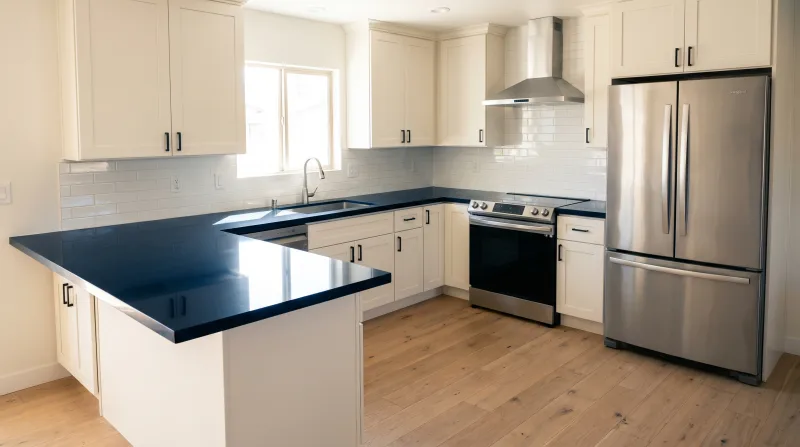
Granite is one of the strongest natural stones you can put in an Arizona kitchen. It tolerates high heat well — you can set a hot pan directly on granite without damage. It's also UV-stable, which matters for rooms with significant sun exposure. The downsides: granite is porous and requires annual sealing in Arizona's dry climate (the sealer breaks down faster with temperature swings), and light-colored granites can show calcium etching from hard Phoenix water near the sink. For homeowners in Scottsdale or Paradise Valley doing full kitchen renovations, granite is a solid long-term choice if you stay on top of sealing.
Quartz (Engineered)
Quartz is the most popular countertop material in the country right now, and it looks great in showrooms. In Arizona, it has a specific and widely underappreciated vulnerability: the resin binders that hold quartz particles together are not UV-stable. Under direct sunlight — near a window, in an outdoor kitchen, or in a sunroom — quartz discolors, yellows, and can even warp. Every major quartz manufacturer voids their warranty for outdoor installation. Quartz also has a lower heat tolerance than granite or lab stone; direct pots off a burner can leave permanent burn marks. For Phoenix homes, quartz works fine in low-light interior kitchens. But if you have south-facing windows, a sunroom kitchen, or any outdoor application, quartz is the wrong material.
Marble
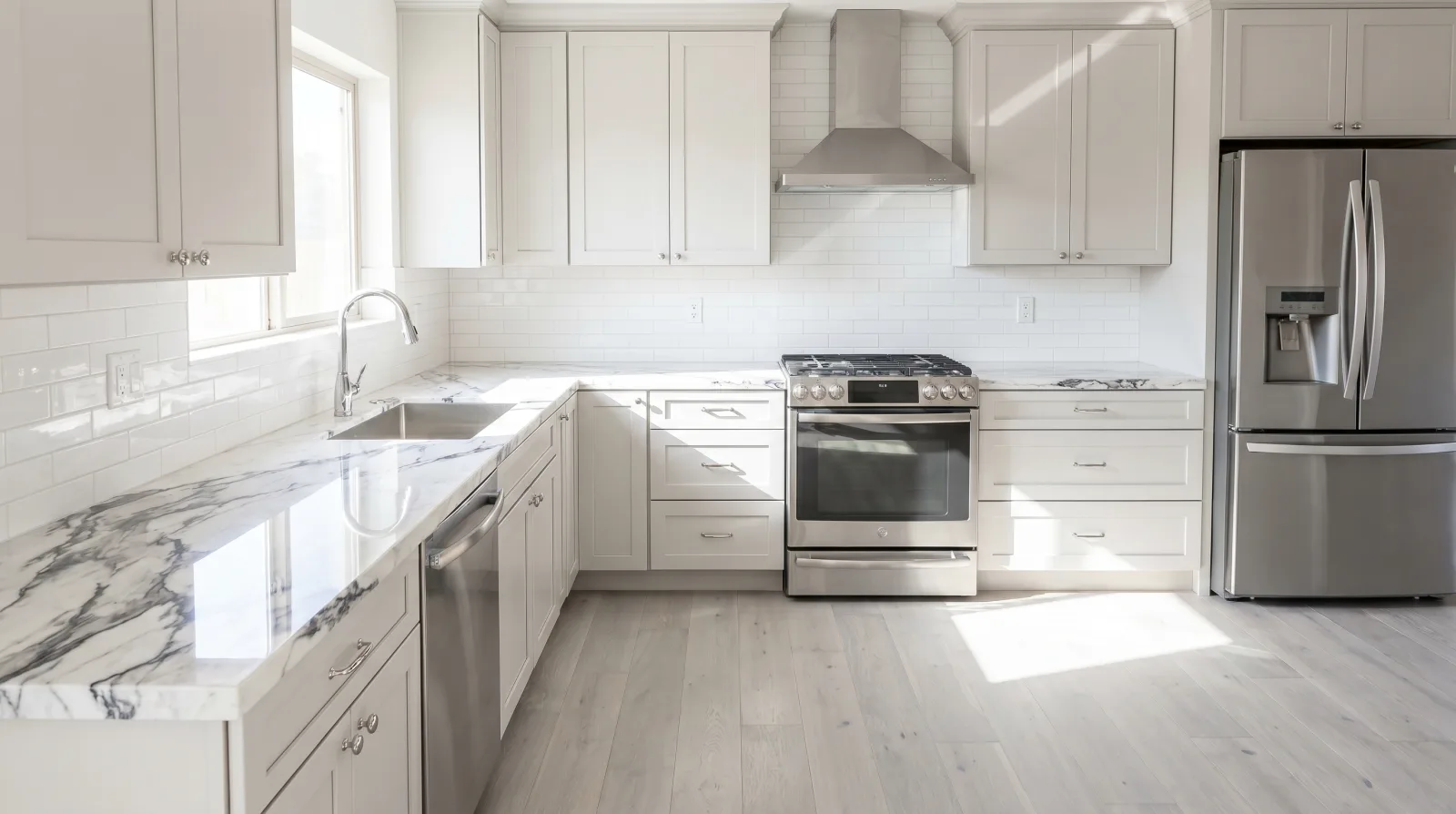
Marble is beautiful and demanding everywhere; in Arizona it's demanding and punished. Marble is soft (3 on the Mohs scale) and highly porous. Phoenix hard water etches marble surfaces visibly and permanently within months — not years. Marble also absorbs heat and can develop thermal stress cracks near seams in large installations that cycle through significant daily temperature variation. If you're set on marble aesthetics, quartzite gives you the visual with substantially better performance. If you're set on actual marble, budget for sealing every six months and accept that the surface will show its age. If what you are actually after is the look — the veining and the depth rather than the stone — a poured finish gives you that without the porosity: emperador over sage cabinets in Moon Valley and pietra grey over whitewashed oak in Verrado are both in the gallery.
Quartzite
Quartzite is real stone, not to be confused with quartz (engineered). It's harder than granite (7-8 Mohs), heat tolerant, and more UV-stable than quartz. The main caveat: quartzite is still porous, still needs sealing, and white quartzites are often misrepresented in showrooms (some "quartzite" is actually marble or a softer stone — ask for a mineral hardness test). For Gilbert, Chandler, or Mesa homeowners who want natural stone with better desert performance, quartzite is worth the premium over marble.
Concrete
Poured concrete countertops are heat tolerant and UV-stable in color if sealed properly. The issue in Arizona is seam performance and maintenance. Concrete develops hairline cracks over time from thermal cycling, especially in large installations. The integral sealer must be reapplied regularly, and in Arizona's heat, maintenance schedules compress. Concrete can work beautifully in desert modern designs but demands an owner committed to care.
Lab Stone
Lab stone — the poured epoxy renovation system we use at Build-A-Counter — was engineered for performance in extreme conditions. The polymer base has flex that natural stone doesn't, making it more resistant to thermal cycling. UV-stabilized topcoats mean colors don't fade under Arizona sun. Because it's poured directly over your existing countertop (no seams, no grout lines), monsoon humidity has nowhere to penetrate. And because it bonds molecularly to the substrate, it doesn't pop, shift, or crack the way adhesive-bonded slabs can when temperature swings are dramatic. For the vast majority of Phoenix metro homeowners — especially those doing renovations rather than new builds — lab stone solves the desert performance problem while giving you a completely new kitchen look at a fraction of slab replacement cost.
How Does UV Exposure Affect Countertop Color?
UV degradation is one of the most overlooked factors in Arizona countertop selection, and it's one of the most visible when it goes wrong. Here's what happens material by material:
Quartz is the most UV-vulnerable countertop material. The resin binders contain carbon-carbon polymer chains that UV-A radiation cleaves over time. The result is yellowing, especially in white and light-gray quartz — the colors Phoenix homeowners most commonly buy. A white quartz countertop near a west-facing kitchen window in Tempe or Apache Junction will show noticeable yellowing within 2-3 years of daily afternoon sun exposure.
Marble and limestone can lighten and lose their veining contrast under sustained direct sun. This is less about polymer degradation and more about photo-bleaching of the iron and mineral oxides that create the color variation in the stone.
Granite is the most UV-stable natural stone. Its crystalline mineral structure doesn't degrade under UV the way polymers or carbonates do. If you have significant sun exposure in your kitchen, granite holds its appearance better than any other natural stone option.
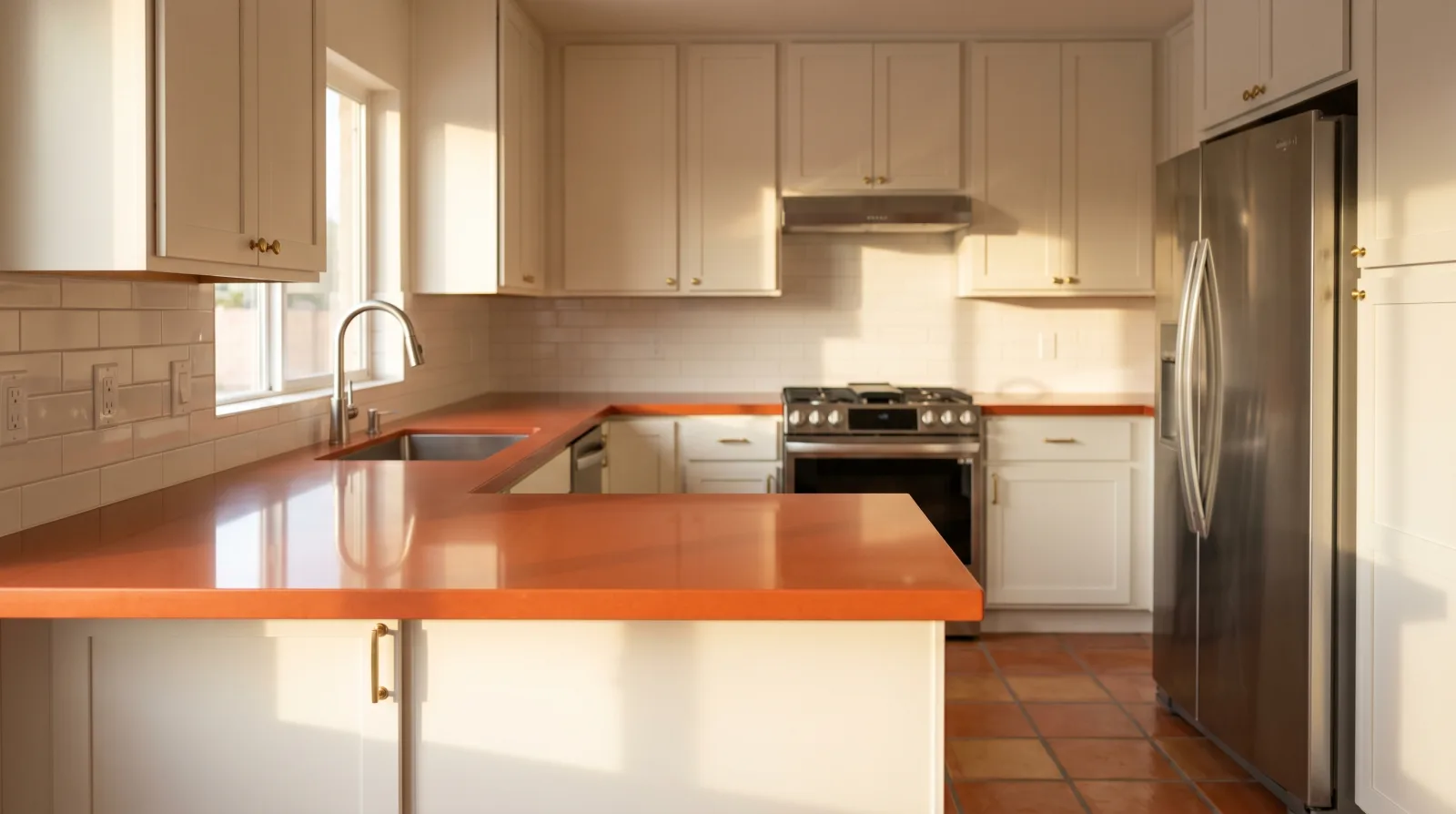
Lab stone uses UV-stabilized pigments that are locked into the topcoat chemistry rather than sitting on top as a dye. The topcoat itself is UV-resistant, meaning the color you choose at the start is the color you keep — even in a Carefree or Fountain Hills kitchen that gets four hours of direct afternoon sun every day. Copper vein over cream cabinets in Maricopa is one of the warmer tones in that range.
What's the Best Countertop for an Arizona Outdoor Kitchen?
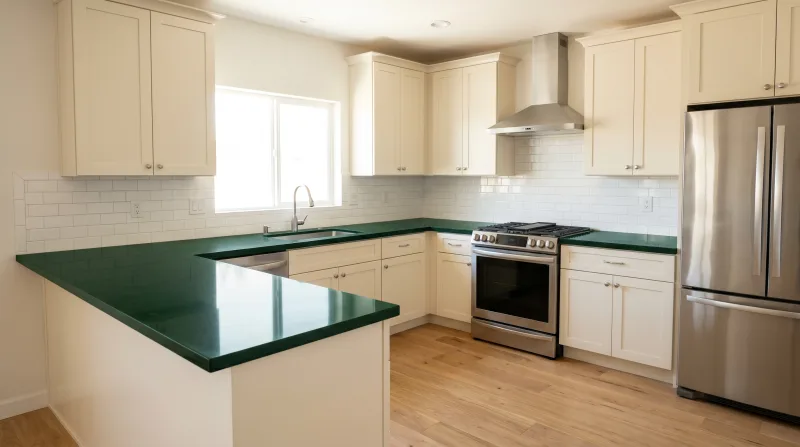
Outdoor kitchens are a point of pride in Phoenix, Scottsdale, Cave Creek, and throughout the East Valley — the weather genuinely supports outdoor cooking nine months of the year. But outdoor countertop selection is where I see the most expensive mistakes.
Do not use quartz outdoors. This is not a gray area. Every quartz manufacturer explicitly voids warranty for outdoor applications. UV exposure will yellow and warp quartz surfaces within 1-3 years in an Arizona outdoor kitchen. I've seen it happen in Ahwatukee backyards. The surface looks fine in shade; direct sun exposure is what breaks it.
For outdoor applications, your real choices are:
- Granite: Excellent heat tolerance, UV-stable, weathers well. Requires sealing once or twice per year in the outdoor environment. Large format slabs can crack if improperly supported, but a professionally installed granite outdoor counter holds up for decades in Arizona conditions.
- Lab stone: Specifically formulated for UV stability, bonds to masonry surfaces common in outdoor kitchen builds (concrete block, stucco substrate), and handles thermal cycling from ambient 115°F to a grill-adjacent 200°F without delaminating. The seamless application means no crevices for monsoon moisture or insects. This is what we recommend for outdoor builds in the East Valley and West Valley.
- Porcelain tile: Technically UV-stable and heat-tolerant, but the grout lines are a maintenance problem in Arizona. Monsoon moisture, Arizona hard water scaling, and outdoor grime embed in grout permanently. If you go tile, use large-format slabs with minimal grout lines and epoxy grout.
How Do Phoenix Homeowners Choose Countertops?
After doing hundreds of consultations across the Phoenix metro — from historic Willo and Roosevelt Row to new builds in Vistancia and Eastmark — I've noticed that Arizona homeowners make countertop decisions in a pretty specific sequence:
First, they go to a slab yard and fall in love with something beautiful. Second, they get the quote. Third, reality hits: full slab replacement in an average Phoenix kitchen runs $4,000–$9,000 installed, and that's before the demolition, plumbing reconnection, and 3-6 week lead time for fabrication and install.
That's when many homeowners start asking different questions. Does the material hold up in Arizona? Is there a way to get this look without replacing everything? How do I avoid another slab replacement in ten years when the quartz starts yellowing?
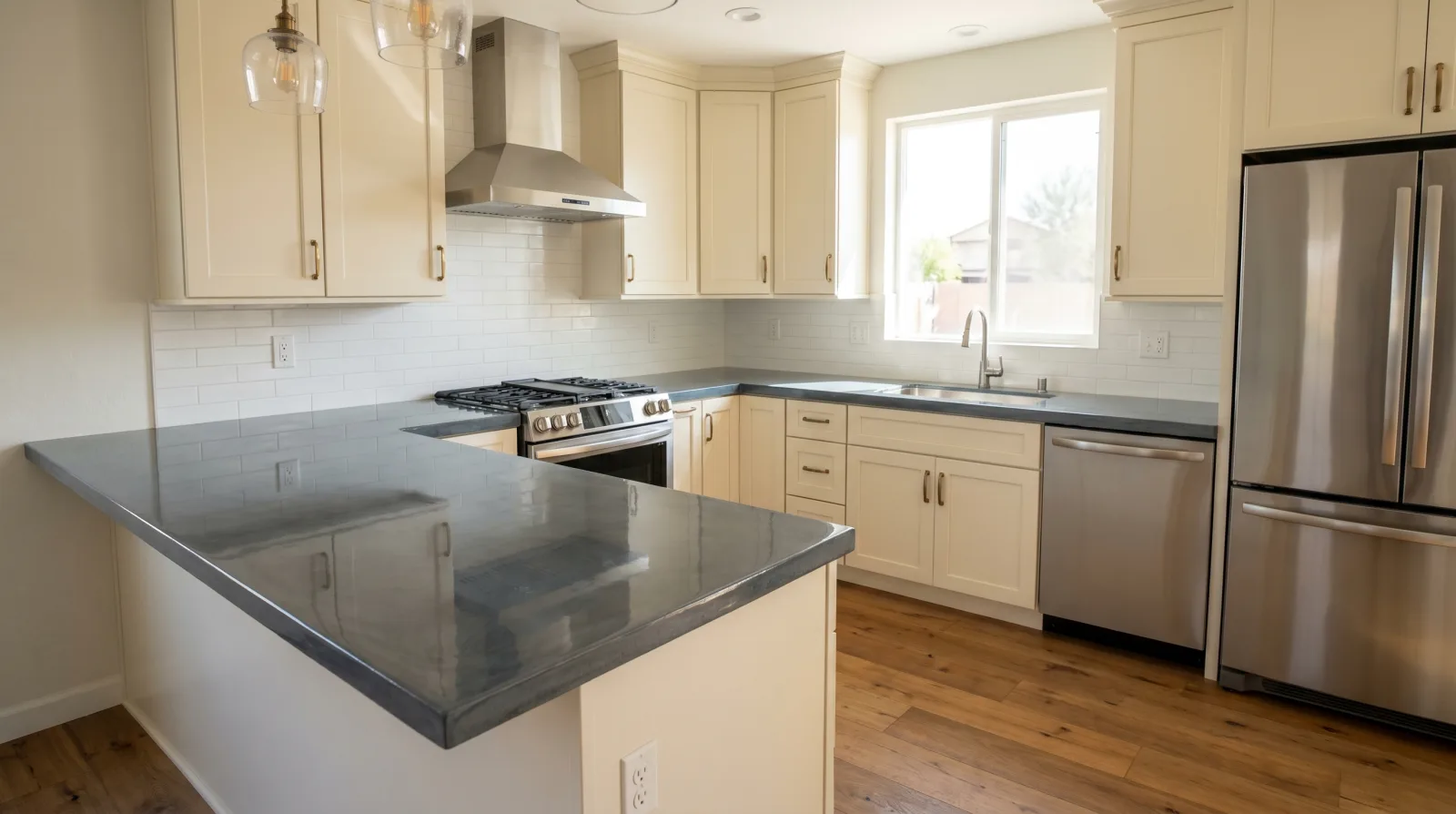
The growing trend in Tempe, Mesa, Gilbert, and throughout the East Valley is renovation over replacement. Instead of tearing out functional countertops that just look dated, homeowners are covering them with lab stone — getting a completely new aesthetic in 24-48 hours, no demolition, no plumbing disconnect, no landfill waste. The final product is a hard, seamless, UV-stable surface that performs better in the Arizona environment than what most homeowners were replacing.
The other thing Phoenix homeowners increasingly ask about is outdoor continuity — they want their indoor kitchen countertop to flow visually with the outdoor kitchen. Lab stone makes that possible because the same finish can be applied to both surfaces, indoor and outdoor, and it holds color consistently in both environments.
What Do Lab Stone Countertops Offer for Arizona Homes?
I want to be direct about this: I'm the founder of Build-A-Counter, and we do lab stone. So take my assessment with that context. But I also spent fifteen years watching slab countertops perform badly in Arizona conditions before I built this company specifically to solve that problem.
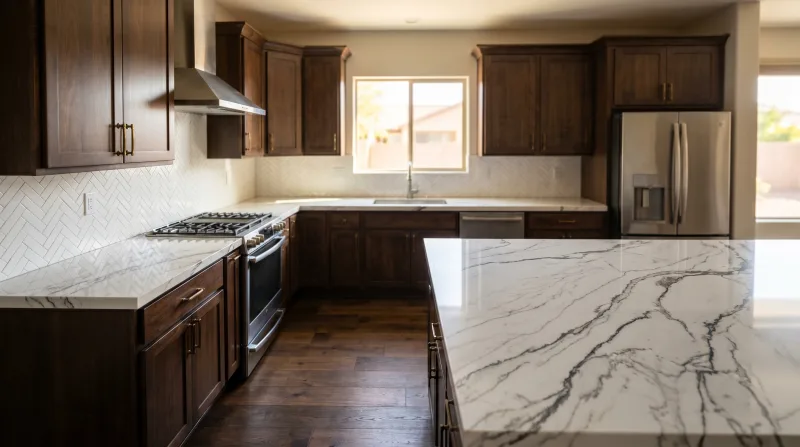
Here's what lab stone actually offers for the Phoenix climate specifically:
Thermal cycling resistance. A polymer-composite surface has flex. Natural stone is rigid — the thermal stress goes somewhere, and over years it goes into micro-cracks. Lab stone surfaces in Phoenix kitchens are still looking clean five years later. We have a documented track record now.
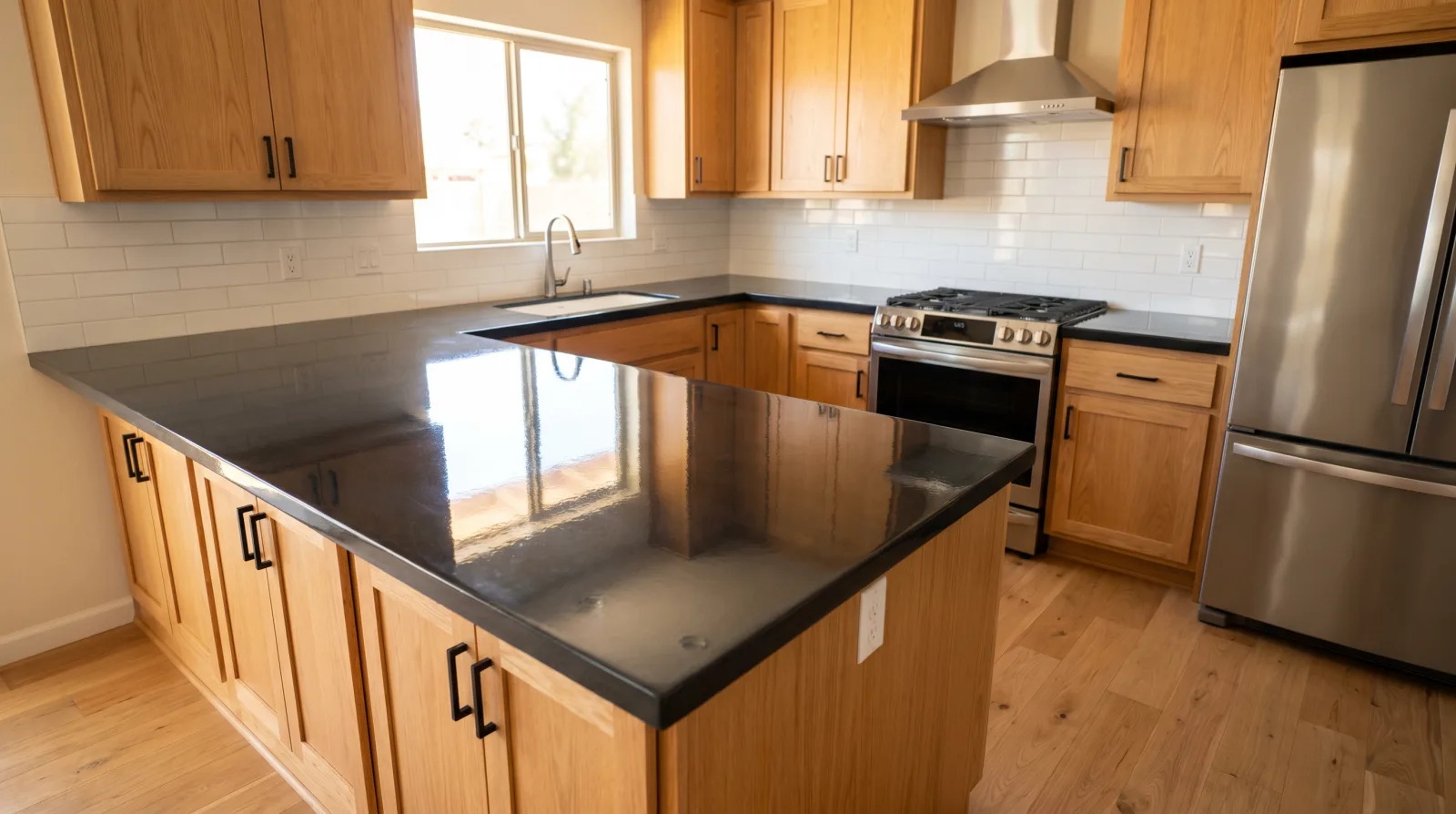
UV-stabilized from the factory. Every finish we pour uses UV-stabilized pigment and a UV-resistant topcoat. The color is stable. If you choose the sand finish popular in Fountain Hills and Cave Creek desert modern kitchens, that finish doesn't drift toward yellow the way quartz does.
No seams. Seams are where granite cracks, where grout gets hard water scale, and where monsoon moisture infiltrates. Lab stone goes on as a continuous pour from sink to edge. There's nothing to seal because there's no seam to fail.
Renovation economics. Arizona homeowners are spending a lot on HVAC, landscaping, pool maintenance, and the general cost of desert living. Getting a kitchen that looks completely new for a fraction of slab replacement cost makes real budget sense here.
Same-day use. After the 24-hour cure, the surface is fully functional. Most slab replacement projects in Phoenix take 4-6 weeks from selection to install, depending on fabricator backlog. Lab stone is usually done in a day.
Those are claims, and claims are cheap. The before and after photos are the version you can check: thirteen Valley counters photographed as they arrived and as they were left.
Arizona Climate — Countertop Material Comparison
| Material | Heat Resistance | UV Resistance | Outdoor Suitable | Cracking Risk | Best For |
|---|---|---|---|---|---|
| Lab Stone ✦ | 9/10 | 9/10 | Yes | Very Low | Renovations, outdoor kitchens, any AZ climate exposure |
| Granite | 9/10 | 8/10 | Yes | Low (with proper install) | New builds, outdoor kitchens, long-term investment |
| Quartzite | 8/10 | 7/10 | Limited | Low–Medium | High-end interiors, natural stone preference |
| Quartz (Engineered) | 6/10 | 4/10 | No | Low (interior only) | Interior rooms with minimal direct sun |
| Marble | 6/10 | 5/10 | No | Medium | Low-traffic bathrooms, aesthetic priority over durability |
| Concrete | 8/10 | 7/10 | Limited | Medium | Custom desert modern designs, committed maintenance owners |
See also: Kitchen countertops in Phoenix and bathroom countertops in Phoenix.