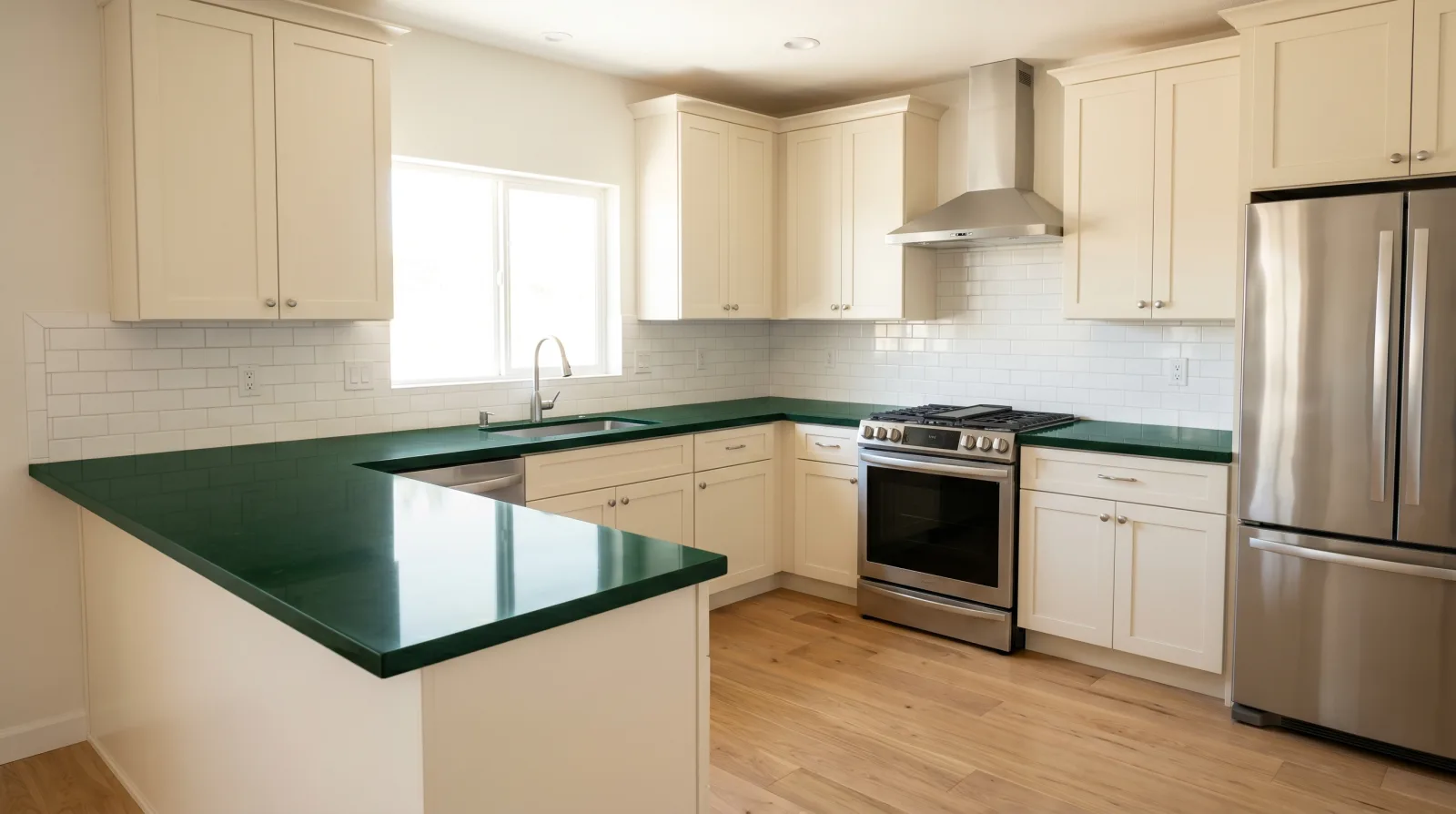
The kitchen countertop trends for 2026 are moving in a clear direction: warmer, bolder, and more personal. After nearly a decade of sterile all-white kitchens and cold gray quartz, homeowners across Phoenix and the rest of the country are demanding surfaces with character. The kitchen countertop trends 2026 shift isn't subtle — it's a full course correction toward materials that feel alive and colors that tell a story.
We work with Phoenix homeowners every week. We see what they're choosing, what they're replacing, and what they're calling about after scrolling Instagram at midnight. This is what's actually happening right now — not trend forecasts based on trade shows, but real decisions real people are making in real kitchens.
What Countertop Colors Are Trending in 2026?
Four color movements are dominating 2026 kitchen renovations, and they don't have much in common with each other — which means there's no single "right" answer. But each one is showing up consistently enough that we can call them trends with confidence.
Warm Earth Tones
Sage green, forest green, and terracotta are the story of 2026. This isn't the electric green of 2021 kitchen experiments. This is deep, muted, organic color — the kind of color you'd find in a canyon wall or a greenhouse. Sage countertops pair naturally with walnut cabinetry and matte brass hardware. Forest green goes darker, almost earthy-black in certain lights, and it works best against cream-white painted cabinets or natural white oak.
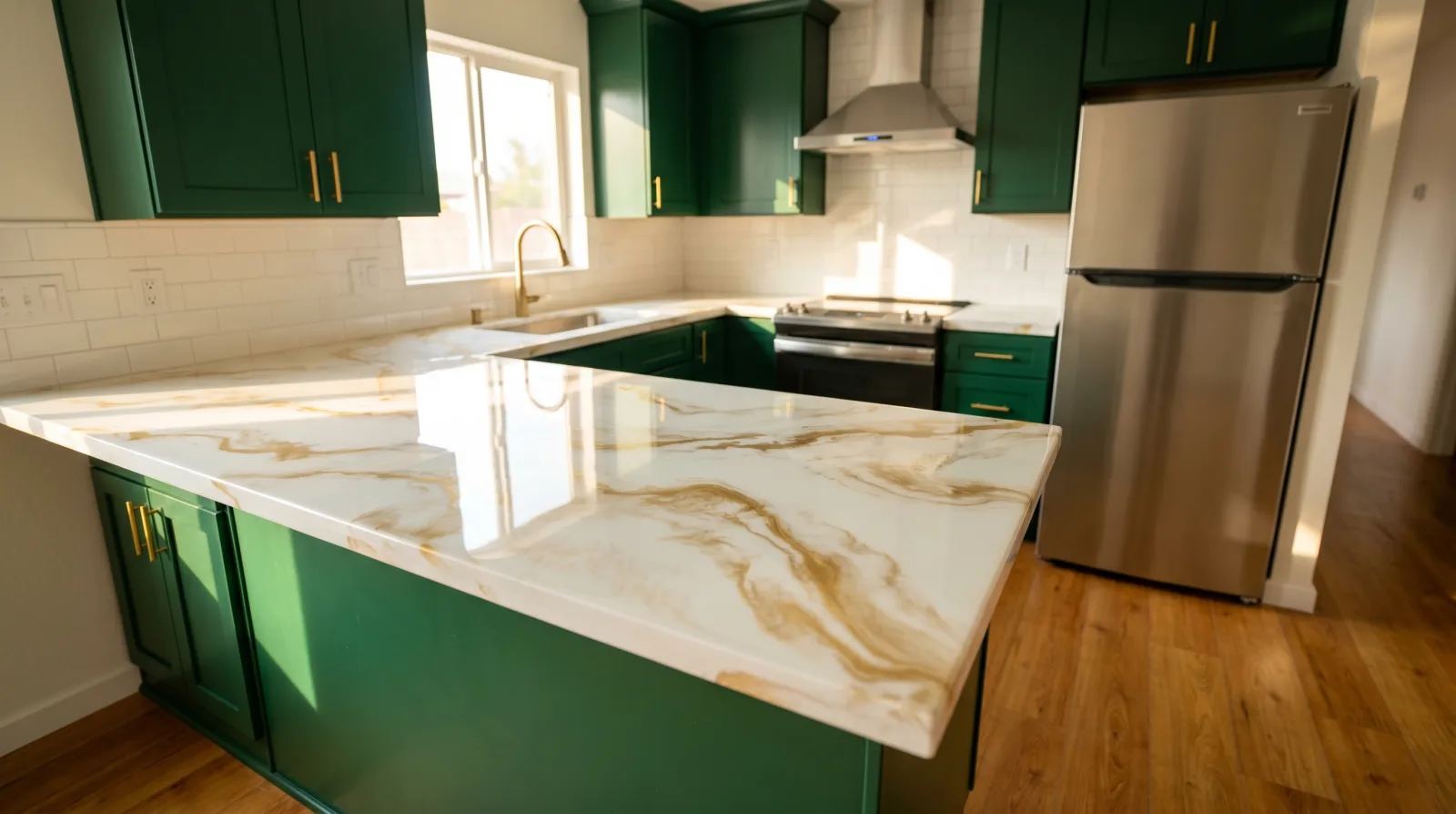
The Forest Green + Cream look we did in Cave Creek captures exactly what this trend looks like at its best — a deep, nearly hunter-green surface sitting on top of warm cream-white cabinetry, with the desert light streaming in from the Arizona windows. It's grounded, organic, and the opposite of cold.
Terracotta is the riskier member of this family. It works when it works — paired with white cabinetry and warm-toned wood flooring, it's stunning. Against cherry cabinets or cool-toned grays? It fights everything. If you're going terracotta, commit to the warm palette throughout the kitchen.
Bold Navy + White Contrast
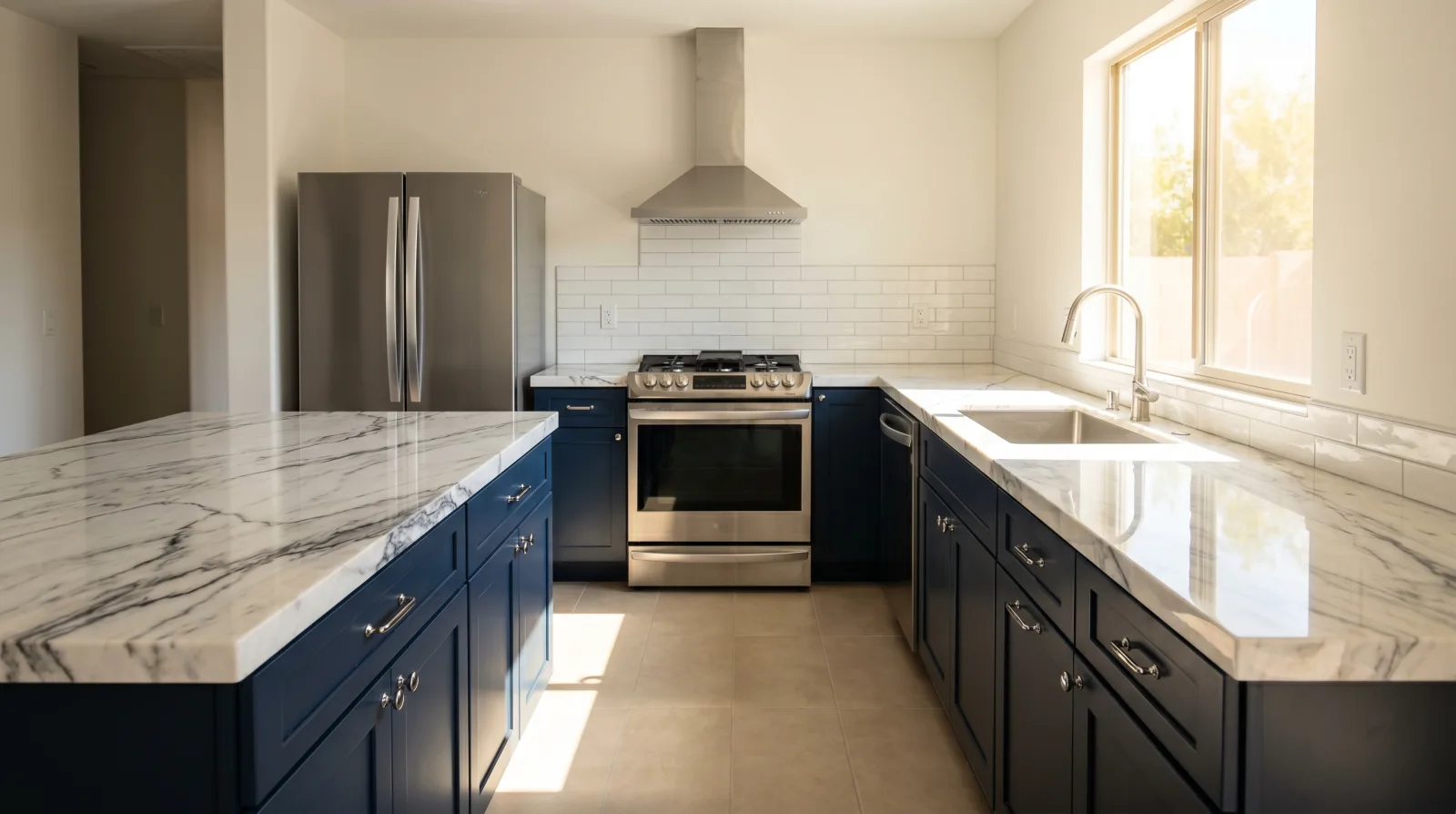
The navy-and-white kitchen has been building for a few years, but 2026 is the year it fully hit the mainstream. White marble (or lab stone marble) against deep navy shaker cabinets is one of the most requested combinations we see. The contrast is dramatic without being loud. It references classic American kitchens — navy has been a kitchen color since the 1940s — but the veined marble surface makes it feel current.
The Calacatta Navy Cabinets look is the benchmark example of this pairing. Calacatta's thick gray veining against the depth of navy creates a look that photographs beautifully and holds up even better in person. This pairing works in open-plan kitchens where the bold navy reads as a design statement from across the room.
Soft Warm Neutrals: Blush and Cream
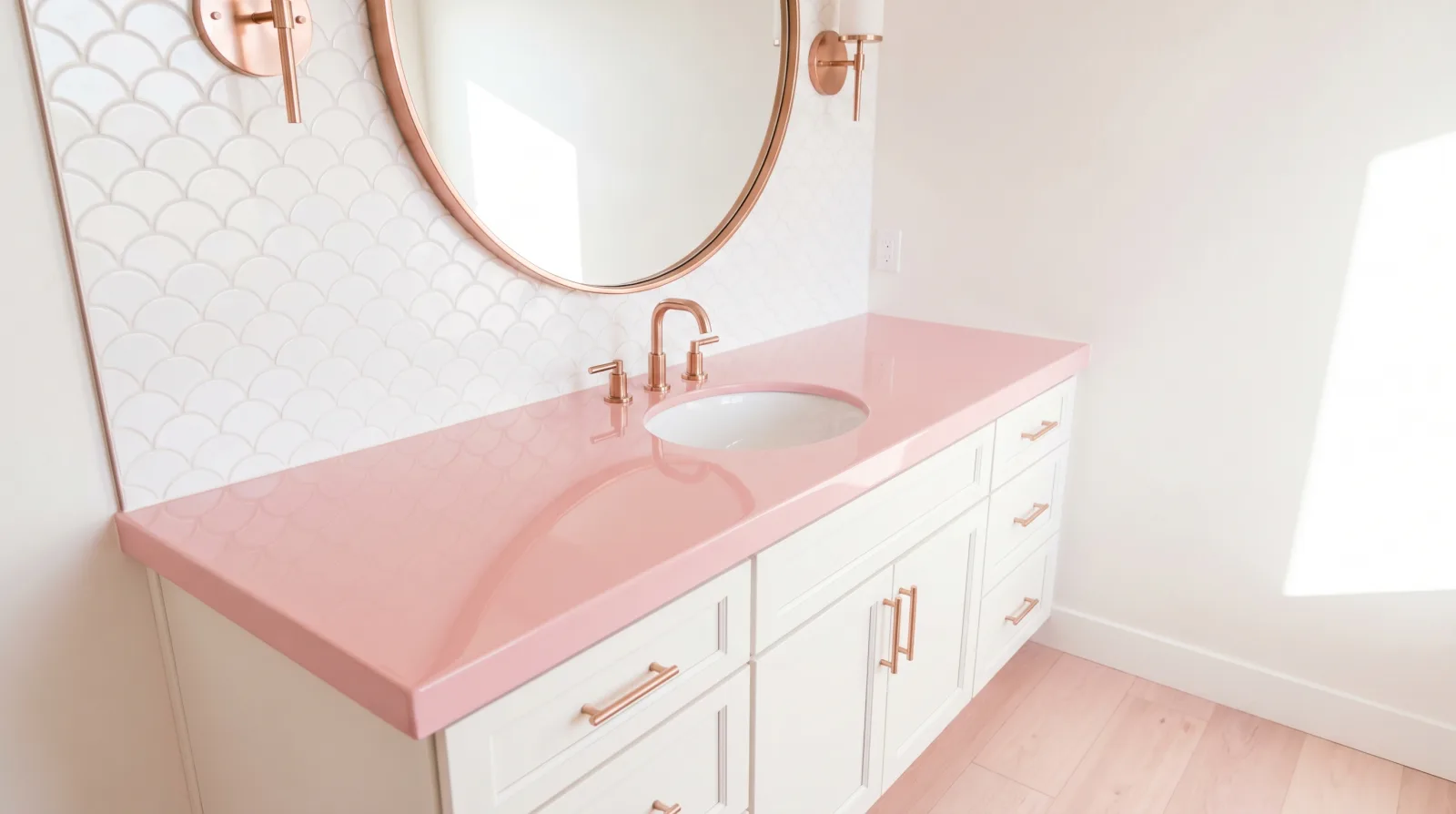
Not everyone wants drama. The third trend is a counterpoint to the boldness everywhere else: soft blush, dusty rose, and warm cream. These are the colors replacing cold gray as the "safe choice that doesn't look safe." Blush has left the bathroom and entered the kitchen. Cream with subtle gold veining is replacing white-on-white for homeowners who want warmth without commitment to a statement color.
The appeal is that these surfaces make kitchens feel warmer in a way that no amount of warm lighting alone can achieve. A blush countertop reflects warm tones into the entire room. With the amount of time most families spend in the kitchen, that matters more than people realize.
Statement Veining
The fourth color trend isn't a color at all — it's movement. Dramatic, large-format veining is getting more dramatic every season. The veins are getting thicker, more expressive, less symmetrical. White and gold veining on white backgrounds. Black veining that runs edge-to-edge in bold diagonal slashes. The veining is becoming the focal point, not just a texture detail.
Curious which of these trends looks right for your kitchen? Configure your layout and try different stone types side by side.
Configure My Counter →Are White Countertops Still in Style?
Yes. Definitively yes. But the category of "white countertop" has split into two subcategories, and only one of them is still growing.
Warm white with dramatic veining: still rising. Calacatta, Bianco Venatino, White Gold, Statuary — these are all technically white surfaces, but none of them are sterile. The white is warm, sometimes ivory, and the veining adds enough visual weight that the countertop has presence. These surfaces don't disappear into the background of the kitchen. They anchor it.
Pure flat white with minimal pattern: declining. The all-white, high-gloss, zero-veining kitchen that dominated 2015–2022 is losing ground fast. Homeowners who installed it are renovating away from it. The complaint is always the same: it looks clinical, it shows every crumb, and it doesn't feel like home. If you're planning a renovation and considering a flat, bright-white surface with no character — pause. It's the one category where we'd push back.
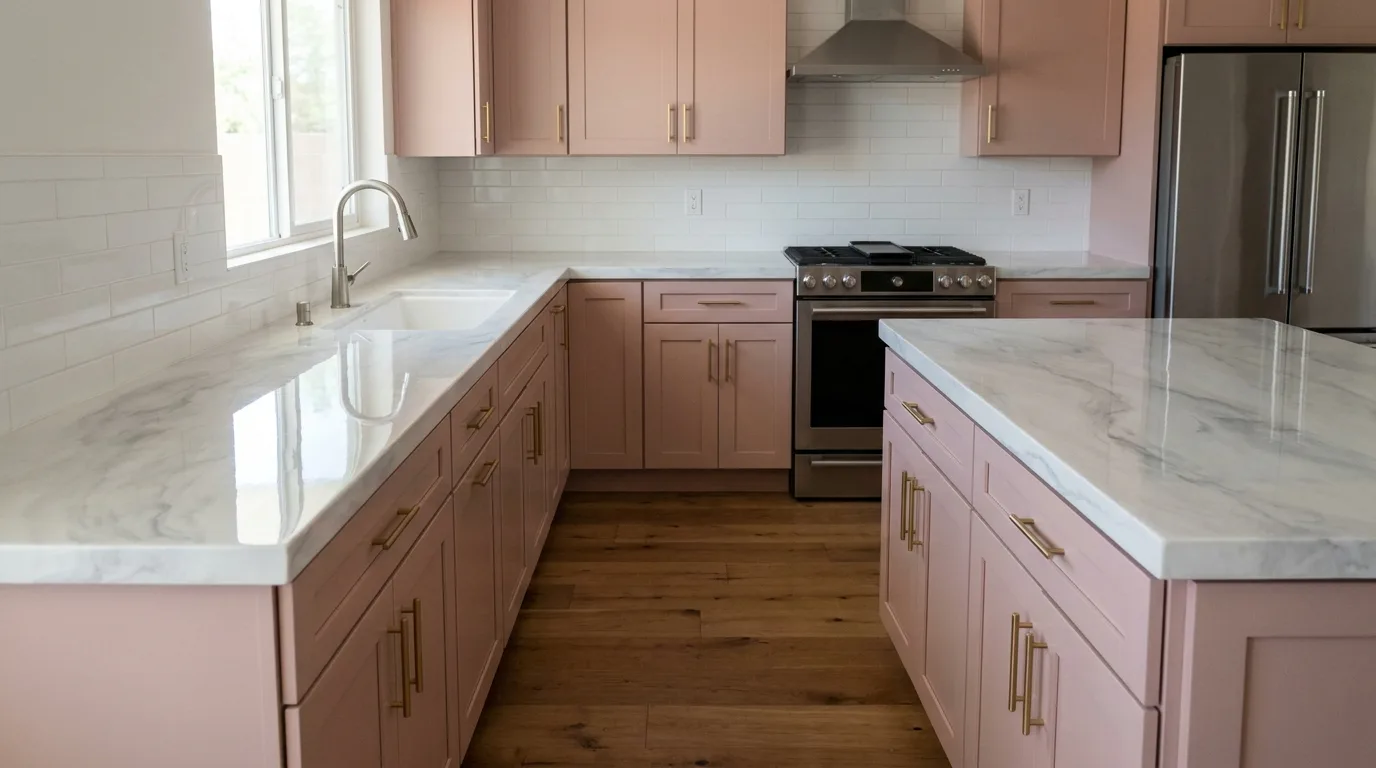
The Bianco Venatino + Blush look in the Biltmore shows exactly how warm white can feel sophisticated rather than sterile. The Bianco Venatino stone has a soft, off-white base with delicate gray veining — nothing aggressive — and against the blush cabinetry, it reads as timeless rather than trendy.
What's the Biggest Material Trend This Year?
The story of 2026 materials is engineered surfaces closing the gap with natural stone — and lab stone emerging as a serious contender for everything.
Lab Stone: The Quiet Revolution
Lab stone — the category Build-A-Counter specializes in — is a poured epoxy surface applied directly over existing countertops. It can replicate the look of any natural stone, including the color, veining pattern, and texture of marble, granite, or quartzite. The practical advantages over natural stone are real: it installs in 24 hours, requires no slab sourcing, and costs significantly less than quarrying and fabricating a natural stone.
What's changed in 2026 is consumer awareness. Lab stone used to require an explanation. Now people are searching for it specifically. They want the visual richness of marble without the sealing maintenance, the weight, and the lead times of natural stone. The renovation market has shifted, and lab stone is capturing the homeowners who want to move fast and spend smart.
Quartzite: Natural Stone's Rising Star
Within the natural stone category, quartzite is gaining on marble. Quartzite looks like marble — sometimes indistinguishably so — but it's harder, less porous, and more resistant to etching from acidic foods. For kitchen applications where cooking actually happens, this matters. White quartzite with gray veining hits the same visual notes as Calacatta marble at lower maintenance cost.
Engineered Quartz: Peak, Not Fading
Engineered quartz (not quartzite — the manufactured material) remains the dominant surface by installation volume. It's not fading, but it's at peak market share. The growth is slowing as lab stone and renewed interest in natural materials pull homeowners in different directions. Quartz still wins on durability, consistency, and price predictability. But as a trend driver? It's no longer leading the conversation.
Sustainability Is a Real Purchase Driver Now
For the first time, sustainability is genuinely influencing countertop choices at scale. Homeowners are asking about sourcing, about carbon footprint, about whether their countertop required quarrying mountain stone in a foreign country. This is playing directly into lab stone's favor — renewing an existing surface requires no new material extraction and dramatically less waste than a full slab replacement.
Matte or Gloss: Which Finish Is Winning?
The honest answer: both. But they're winning in different rooms and for different stone types.
Matte finishes have been building since 2020, and they're not going anywhere. Matte surfaces hide fingerprints better, feel more organic, and photograph beautifully with natural light. On darker surfaces — charcoal, forest green, slate — matte is almost always the right call. The texture becomes part of the surface's identity rather than competing with it.
High gloss is making a genuine comeback. After years of matte dominance in design media, high-polish finishes are reappearing — specifically on white and cream surfaces with dramatic veining. A high-gloss Calacatta countertop in morning light is a different object entirely from its matte counterpart. The light catches the veining and amplifies it. For homeowners who want maximum visual impact from a white marble surface, gloss is the correct finish choice.
The White Gold + Emerald look in Carefree makes a strong case for gloss. The White Gold stone has gold veining that would be significantly quieter in matte — the polish is what makes those veins sing against the emerald cabinet backdrop.
Bookmatched veining is the finish trend that exists beyond the gloss/matte debate. Bookmatching — mirroring two adjacent slabs so the veining pattern is symmetrical across the centerline — is moving from high-end installations into more accessible spaces. As lab stone techniques improve, bookmatched veining patterns are achievable even in the renovation market.
What Cabinet Colors Go With Marble Countertops?
This question comes in constantly, and the answer has shifted notably in 2026 compared to even three years ago.
Navy cabinets remain the classic high-contrast pairing. Navy is forgiving — it works with nearly every marble variation, from the warmest cream-background stones to the coolest pure whites. It references nautical tradition without feeling coastal unless you want it to. The Calacatta Navy pairing is our most-viewed look for good reason.
Sage green cabinets are the 2026 pairing story. The combination of white or cream marble on sage green painted cabinetry taps directly into both the earth tone trend and the warm neutral trend simultaneously. It's an organic, naturalistic palette that feels both contemporary and timeless. The key is choosing the right sage — too gray and it reads cool; too yellow-green and it fights the marble. The sweet spot is a muted, slightly warm sage.
Walnut wood is the answer for homeowners who want warmth without color commitment. Natural walnut against white marble is one of the most universally flattering pairings in kitchen design. The wood's warm brown tones balance the marble's cool whites and grays perfectly. It reads modern and organic simultaneously.
Matte black is the choice for maximalist kitchens where the countertop is supposed to be a statement. Black cabinets under bold marble veining is a lot of visual information — it requires confidence in the design, proper lighting, and usually a simple backsplash to prevent visual overload. When it works, it's genuinely stunning.
What's Falling Out of Style in 2026?
Trend reporting without the declining side is incomplete. Here's what homeowners are actively moving away from.
Gray everything. The all-gray kitchen — gray quartz, gray walls, gray backsplash, gray cabinets — had a long run from roughly 2012 to 2023. That run is over. Gray is being replaced by everything discussed above: warmer, more specific colors that communicate a design point of view. If your current kitchen is uniformly gray and it feels cold, you're not imagining it — the cultural moment for that palette has passed.
Granite (as a status signal). Granite isn't going away — it's a durable, practical material that will always have a place. But it's no longer aspirational. Homeowners who want to signal a premium kitchen renovation are choosing marble, quartzite, or lab stone. Granite is the practical choice now, not the luxury choice.
Stark white + stainless steel. The restaurant-kitchen-aesthetic in residential spaces — all-white surfaces, commercial-grade stainless appliances, zero warmth — peaked around 2019. The pandemic and the years that followed pushed people toward kitchens that feel like living spaces rather than food-preparation zones. The all-white-and-steel kitchen reads cold now in a way it didn't five years ago.
Busy backsplash + busy countertop combinations. For most of the 2010s, mixing bold tile backsplash with bold patterned countertops was considered sophisticated eclecticism. Now it mostly reads as two surfaces competing for attention. The current preference is letting one surface lead — either a statement countertop on a simple backsplash, or a statement backsplash on a quiet surface.
How Can You Get These Trends for Less?
Natural stone is expensive. A single slab of genuine Calacatta marble in Phoenix — sourced, cut, fabricated, and installed — can run $150 to $300 per square foot depending on the thickness, finish, and contractor. For a typical kitchen with an island, that's a real number.
Lab stone closes the gap significantly. A Build-A-Counter lab stone renovation — same marble-look surface, same design options, installed directly over your existing countertop — runs a fraction of natural stone's installed cost. The reason is structural: we're not quarrying anything, not cutting slab, not managing material logistics across a supply chain. We apply the surface directly in your kitchen. The lead time is 24 hours, not 6–8 weeks.
Lab stone also reduces risk. With natural stone, you're committed the moment the slab is cut. With lab stone, if your taste shifts in three years, the renovation investment is lower and the re-renovation path is more practical. For the homeowners we see most — families in Phoenix who want a beautiful kitchen but aren't planning to stay in the same house forever — the economics of lab stone are genuinely compelling.
The Blush look in Litchfield Park is a good example of lab stone achieving a result that reads natural. The solid blush finish has depth and warmth that flat-painted surfaces can't replicate. At the price point of a lab stone renovation, it's accessible to a market that would be priced out of natural stone entirely.
2026 Countertop Trends at a Glance
| Trend | Status | Best Pairing | See It In Action |
|---|---|---|---|
| Earth tones (sage, forest, terracotta) | Rising ↑ | Cream cabinets, walnut, brass hardware | Forest + Cream — Cave Creek |
| Navy + white marble contrast | Peak | Navy shaker cabinets, polished nickel | Calacatta Navy |
| Warm neutrals (blush, cream) | Rising ↑ | White or pale gray cabinets, rose gold | Blush — Litchfield Park |
| Statement bold veining | Rising ↑ | Simple cabinets, minimal backsplash | White Gold + Emerald |
| High-gloss marble finish | Comeback ↑ | White/cream marble surfaces only | Bianco Venatino — Biltmore |
| Matte dark surfaces | Peak | Light wood, matte black hardware | Calacatta Navy |
| Lab stone renovation | Rising ↑ | Any cabinet color, any design goal | Configure & Price |
| All-gray kitchen | Fading ↓ | N/A — moving away from this palette | — |
| Pure flat white, no veining | Fading ↓ | N/A — replace with warm white options | — |
| Granite as luxury signal | Fading ↓ | Still practical — no longer aspirational | — |
One note on reading this table: "Peak" doesn't mean bad. A trend at peak is still the right choice for millions of kitchens. Navy + white marble is one of the most proven pairings in kitchen design history. Peak means it's no longer the emerging option — it's the established one.
See also: Kitchen countertops in Phoenix.