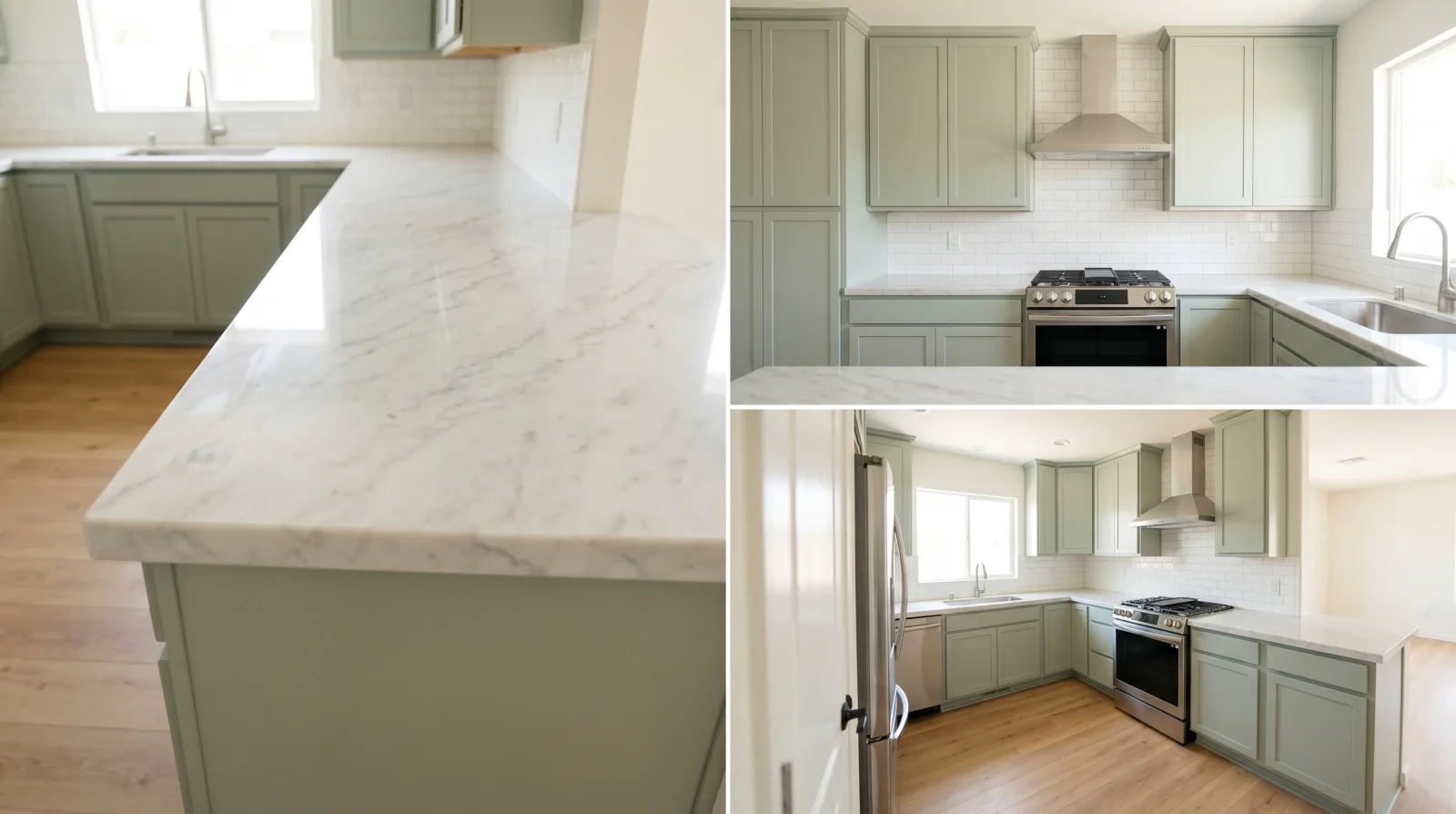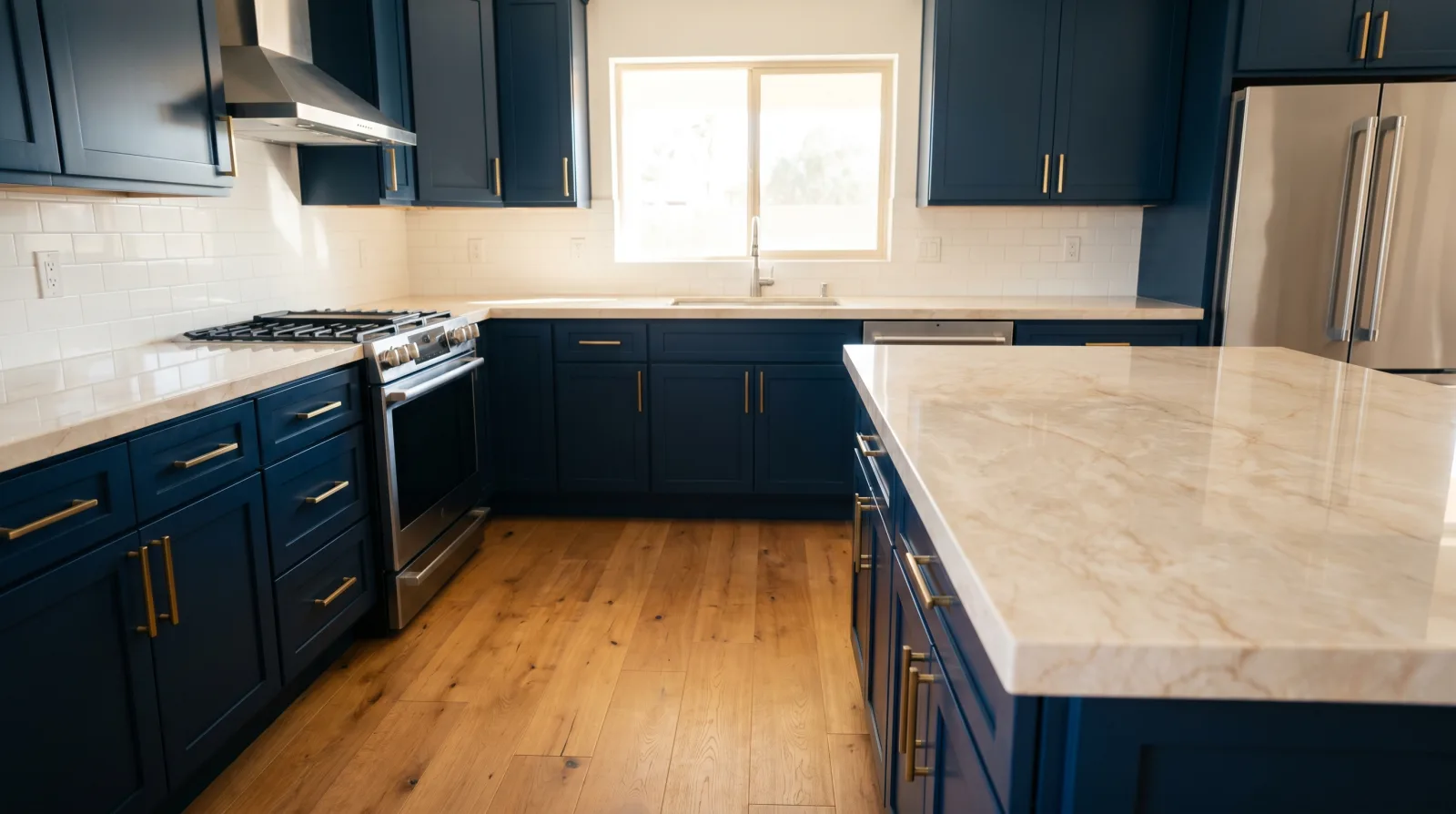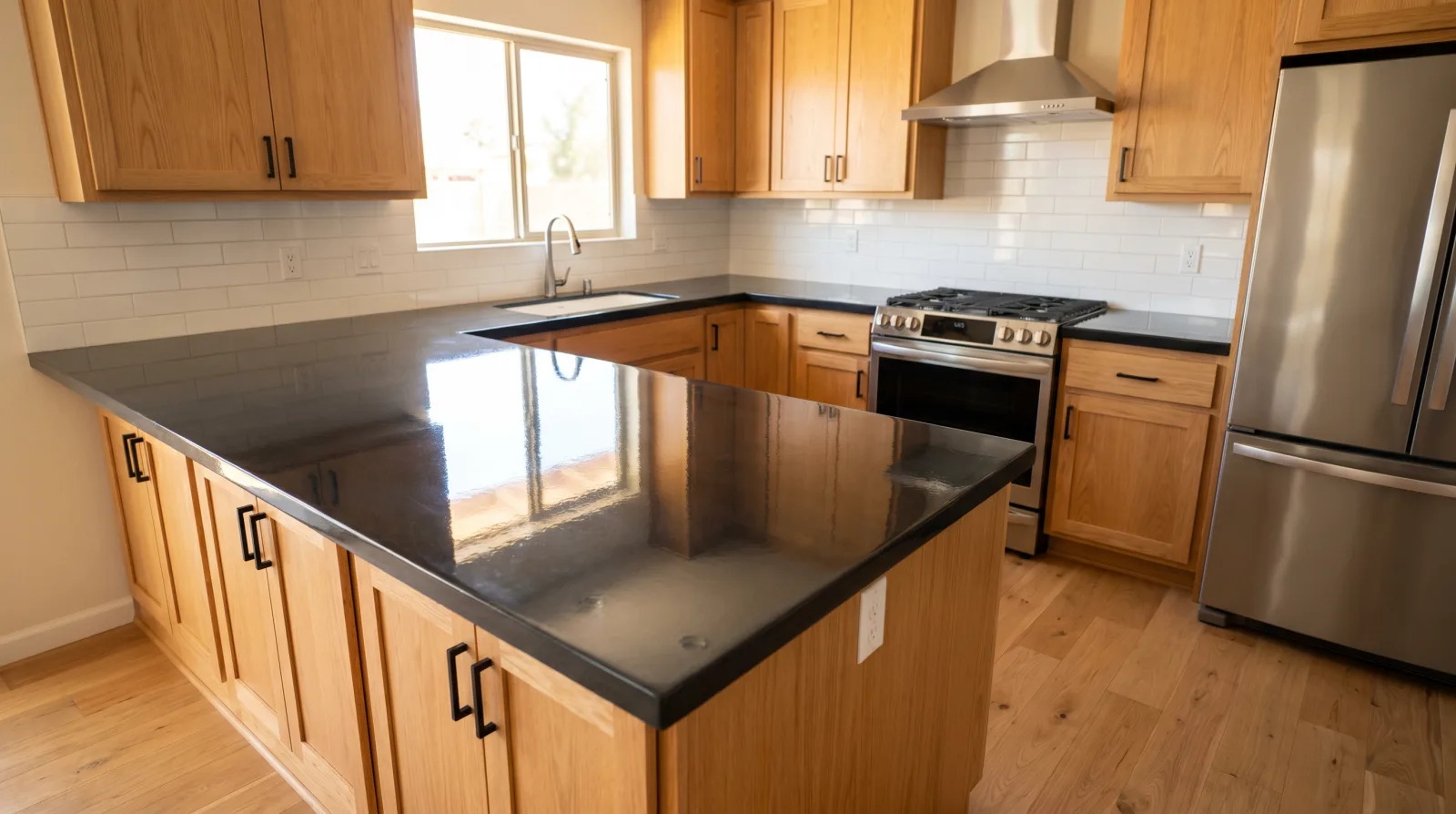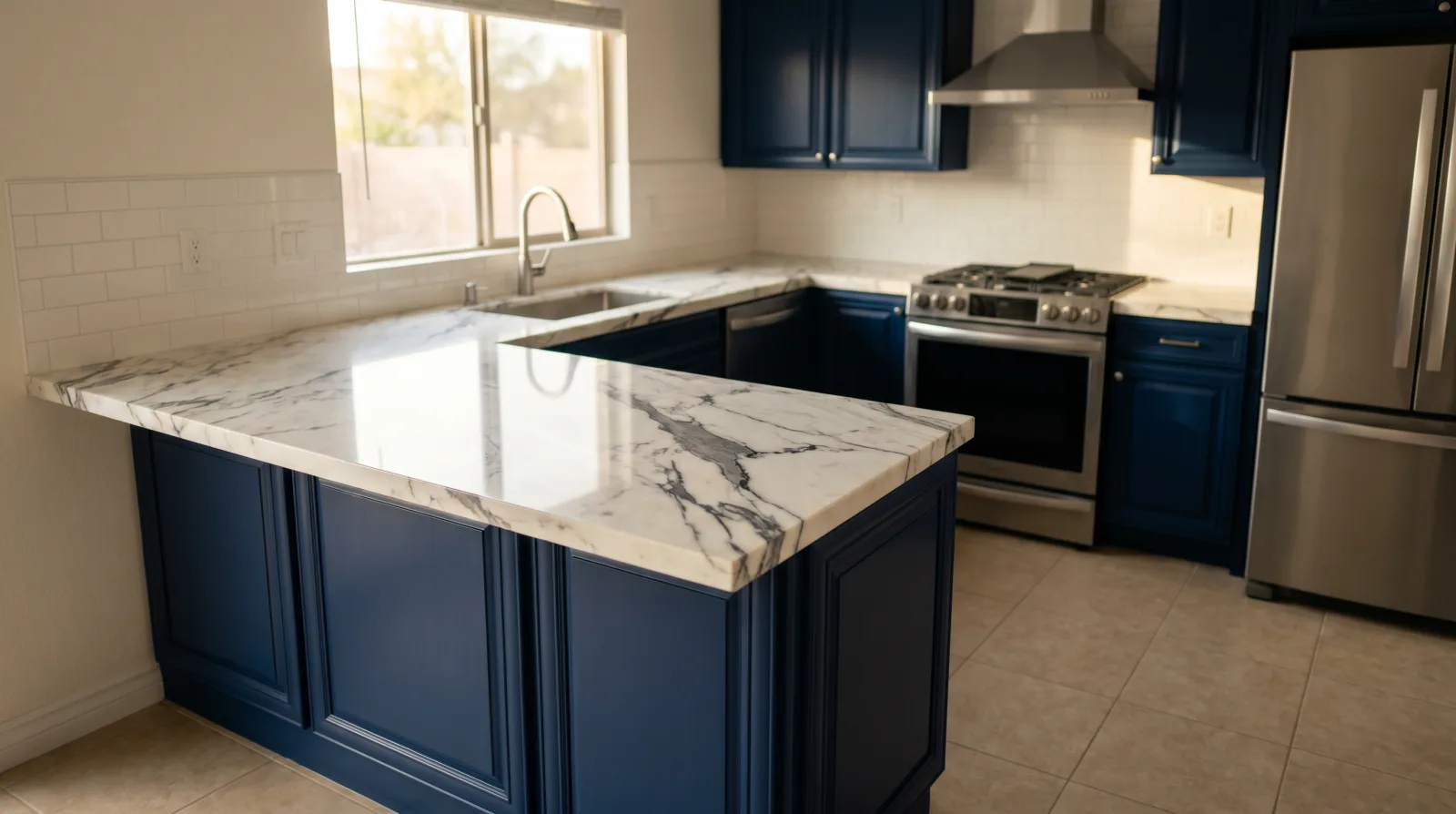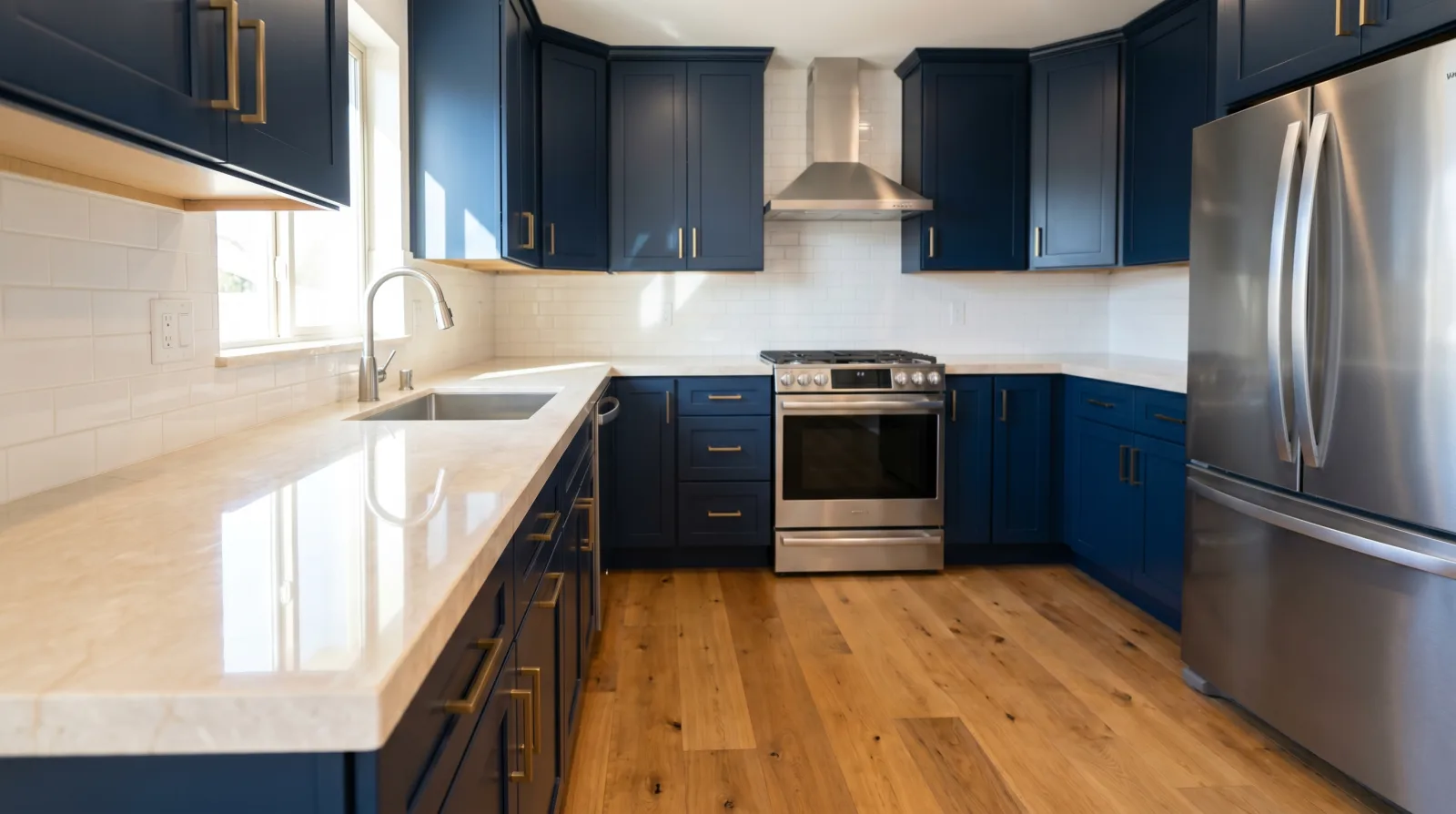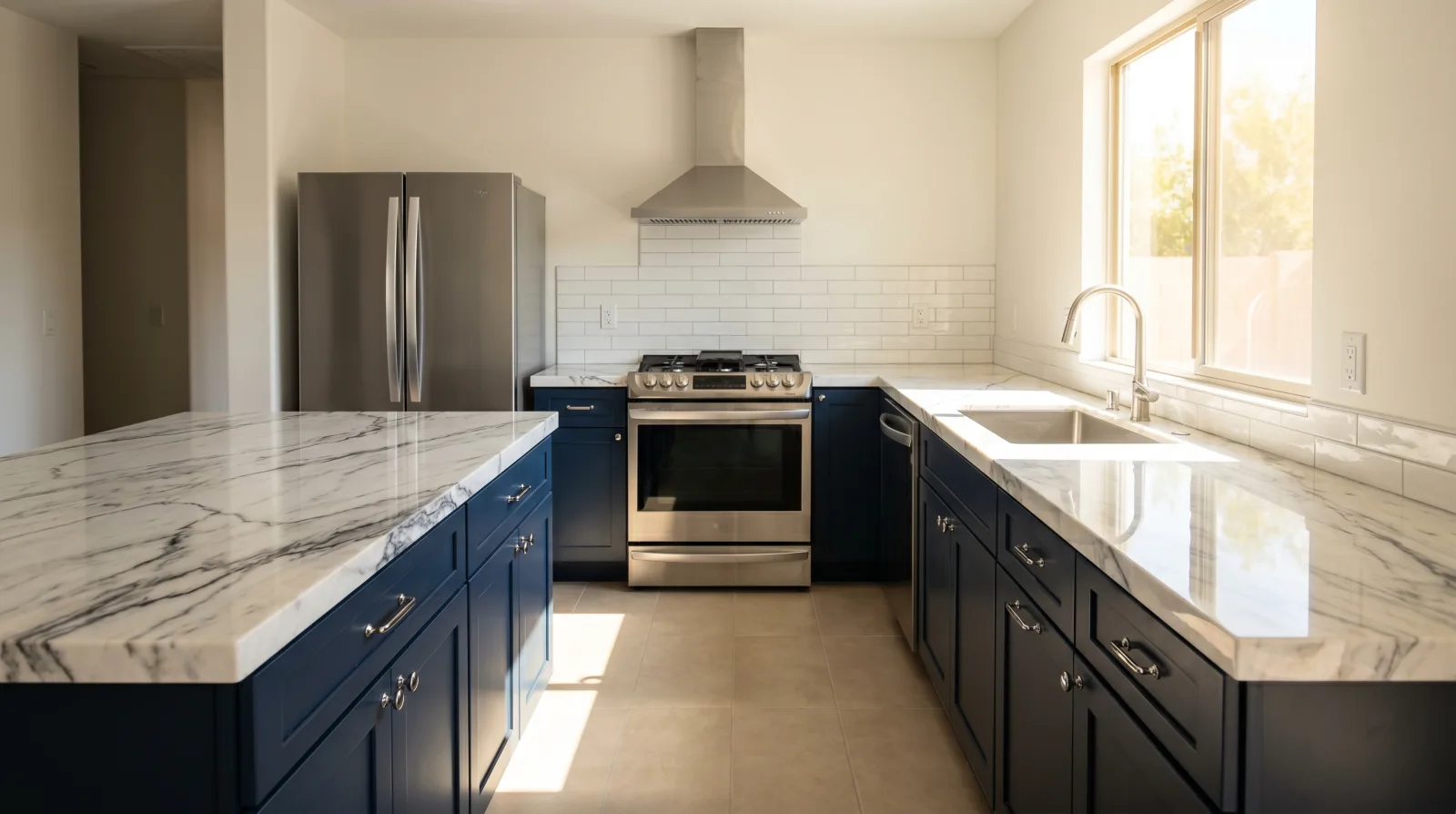
The most common question we get before a quote is some version of: what's this going to cost me? Fair question. Countertop pricing is notoriously opaque — contractors throw out big numbers before they've even seen your kitchen, and online estimates range so wildly they're useless. So here's the straight answer on lab stone countertop cost, backed by real jobs we've done in the Phoenix metro.
The short version: a lab stone kitchen is $999 installed whatever its size. A typical whole project — kitchen plus a bath or two — runs around $1,900. And it's done in a single day — no demolition, no fabrication delays, no weeks of eating off a folding table in your living room.
Below, we break down every cost factor so you know exactly what you're getting into before you call.
What Does a Lab Stone Kitchen Cost?
Lab stone is not priced per square foot. A kitchen is $999 installed, whatever its size or layout. That's the all-in number — material, labor, surface prep, sealing, and cleanup included. There's no separate line item for installation because the material and labor aren't separable the way they are with slab countertops.
Because the price is flat per room, here is what real projects come to:
- Kitchen, any size or layout: $999
- Half bathroom: $299
- Full bathroom: $499
- Kitchen plus a half bath: $1,298
- Kitchen plus two full baths and a half bath: $2,296
The $999 kitchen price is flat because the cost of mobilizing a crew, staging materials, and traveling to your home does not change with counter length. We don't do jobs below the $299 half-bath threshold — it doesn't make sense for either side of the transaction. Counter length does not change the price.
To put those numbers in context: a traditional granite countertop job in Phoenix typically runs $80–200 per square foot all-in after you add fabrication, templating, delivery, and installation. Quartz runs $50–150 per square foot. A $999 flat-rate lab stone kitchen isn't a comparable product — it's a fundamentally different category of economics.
Want to see what your specific kitchen would cost? Our online configurator gives you a real price estimate in about 3 minutes.
Get My Free Estimate →What's Included in the $999 Starting Price?
We get specific about this because "installed" means different things from different contractors. Here's exactly what's included in every Build-A-Counter job, no asterisks:
- Material: The lab stone compound itself — a mineral-rich, poured epoxy formulation that mimics the look of natural stone with the durability of a cured surface.
- Surface preparation: Cleaning, sanding, and priming your existing countertops so the lab stone bonds correctly. We're going over your current surface, not removing it.
- Color and finish application: Hand-applied in layers to achieve your chosen look — marble veining, solid color, or a blended effect.
- Heat cure: We use a torch cure process to accelerate hardening and lock in the finish. Same day.
- Final sealing: A protective topcoat that makes the surface food-safe, waterproof, and stain-resistant.
- Full cleanup: We leave your kitchen cleaner than we found it.
What's NOT included:
- Sink replacement or plumbing work
- Faucet or fixture upgrades
- Backsplash tile work
- Cabinet painting or replacement
- Structural repairs to damaged substrate (soft spots, water damage beneath the surface)
- Permit fees — though lab stone renovation typically doesn't require a permit in Arizona under the handyman exemption
If your existing countertop has structural damage underneath — a soft laminate base, a cracked tile substrate, or delaminating plywood — that needs to be addressed before we apply lab stone. We'll catch this during the quote walkthrough and tell you upfront what it adds to the cost. Usually it's minimal.
How Does Lab Stone Compare to Other Countertop Materials?
Let's put the numbers side by side. This table covers the five materials most Phoenix homeowners consider when they're updating a kitchen. All prices reflect Phoenix metro market rates in 2026, including installation.
| Material | Price/Sqft (installed) | Avg Kitchen Total | Install Time | Maintenance | Sealing Required |
|---|---|---|---|---|---|
| Lab Stone (BAC) | Flat, not per sqft | $999 flat | 8–12 hours | Low | No (pre-sealed) |
| Laminate (DIY or installed) | $10–40 | $800–$2,800 | 1–3 days | Medium | No |
| Quartz (engineered) | $50–150 | $3,500–$9,000 | 3–7 days | Low | No |
| Granite (natural slab) | $80–200 | $5,000–$12,000 | 5–10 days | Medium | Yes (annually) |
| Marble (natural slab) | $100–250 | $6,500–$15,000 | 5–10 days | High | Yes (every 6–12 mo) |
A few things worth noting about that table:
Granite and quartz prices include demolition. Before a slab countertop goes in, your existing countertops have to come out. That's typically $300–600 in labor just for removal and disposal, before the new material is even ordered. Lab stone installs over what you have. No demo, no dumpster, no mess that lasts three days.
Quartz is not the budget option it used to be. Supply chain disruptions and increased demand have pushed quartz pricing significantly higher in the Phoenix market over the past two years. Entry-level quartz from big-box stores now frequently runs $60–80 per square foot before you add templating and installation.
Laminate is a fair comparison on price, but not on finish. Quality laminate is an honest product and we don't disparage it. But high-end laminate still looks like laminate up close, it edges visibly, and it doesn't add the same visual weight to a kitchen that stone — real or lab — does.
Lab stone's closest aesthetic competitor is quartz. Both give you a seamless, stone-look surface with low maintenance. The gap in installed cost — a flat $999 kitchen versus $50–150 per square foot — comes entirely from the delivery mechanism. Quartz is a 400-pound slab that has to be cut, transported, and craned into your home. Lab stone is mixed and poured on-site. The finished look is comparable. The logistics are not.
What Factors Affect Your Total Lab Stone Cost?
Same as any construction project, your final number depends on specifics. Here are the variables that move the price up or down from the average.
Surface Area
This is the biggest lever. Every square foot of countertop surface — perimeter counters, islands, breakfast bars, window sills — gets counted. Standard kitchen countertop depth is 25 inches, so a 12-foot run of counter is 25 square feet. If you're not sure how to measure, the configurator walks you through it, or we measure for you during the quote visit — and standard kitchen countertop dimensions has the numbers and the spots where Phoenix tract layouts differ from them.
Stone Pattern Complexity
A pure white or solid color finish is the fastest to apply. Complex veining — like a full Calacatta Marble with bold gold veining running across the full counter — takes more time and skill. It takes us longer, but the price does not change — a kitchen is $999 whichever finish you choose.
Existing Surface Condition
Lab stone can go over laminate, ceramic tile, butcher block, and existing stone — but the surface needs to be structurally sound. If you have lifting tile edges, soft laminate sections, or areas with water damage below the surface, those get addressed first. In most cases, repairs run $100–300 and the existing material is consolidated rather than replaced.
Number of Rooms
Adding bathrooms to a kitchen job is the highest-value upgrade on our pricing sheet. The mobilization cost is already paid for when the crew is at your house. A primary bathroom vanity typically adds $250–500 to a kitchen job. A guest bath adds another $200–400. Doing all three in one visit saves you a separate mobilization cost, which is meaningful.
Edge Profile
A square or eased edge is included in the base price. If you want a bullnose, ogee, or beveled edge profile, there's a small upcharge — typically $3–6 per linear foot. Most clients keep it simple; the stone surface is doing the visual work, and a clean square edge looks intentional next to good cabinetry.
Location Within Phoenix Metro
We're based in Phoenix and serve the full metro — Scottsdale, Chandler, Gilbert, Mesa, Tempe, Peoria, Glendale, and beyond. Travel time factors into pricing for far east Valley or far west Valley locations. Jobs in Wickenburg or beyond the standard service radius get a fuel surcharge of $50–100.
How Does the 24-Hour Installation Save You Money?
The speed of lab stone installation isn't just convenient — it has real financial implications that most homeowners don't think about when comparing quotes.
No temporary kitchen costs. A granite or quartz countertop job in Phoenix typically takes 5–10 days from demo to completion. That's 5–10 days where your kitchen is non-functional. Some families manage. Others end up spending $500–1,200 on takeout, restaurant meals, and paper plates over the install window. Lab stone is done in one day. You're cooking dinner that night.
No structural risk from demo. Demolishing existing countertops in an older home is never clean. Tiles shatter, laminate adhesive pulls chunks of drywall, plumbing connections get disturbed, backsplash tile cracks. Every one of those is a potential cost overrun. Lab stone eliminates demo entirely. The risk doesn't exist if the saw never comes out.
No fabrication scheduling delays. Slab countertops are cut to template at a fabrication shop, which means you're in a production queue. In Phoenix, that queue currently runs 2–4 weeks. If your template gets cut wrong — a common occurrence — you're back in the queue. Lab stone is mixed on-site to the exact dimensions of your counter. If something needs adjustment, it's adjusted before it cures.
No hidden installation fees. Slab countertop quotes rarely include everything upfront. Templating fees ($150–300), delivery charges ($200–400 for heavy slab transport), plumber for sink reconnection ($150–400), and haul-away for old countertops ($200–350) often get added after the initial quote. Our $999 starting price is the real number.
When you add those carrying costs up — meals, potential demo damage, fabrication delays, and installation line items — the realistic cost gap between lab stone and granite often exceeds $3,000 on a standard kitchen, on top of the material cost difference.
Is Lab Stone a Good Investment for Resale Value?
This is the question from the financially savvy homeowner, and it deserves a direct answer.
Countertop upgrades consistently rank among the highest-ROI home improvements in Phoenix. The National Association of Realtors consistently shows kitchen updates returning 60–80% of cost at resale. But that math assumes you're spending $8,000–15,000 on a kitchen renovation. When your total countertop investment is $1,500–2,500, the calculation changes entirely.
Here's the practical reality: buyers walking through a kitchen in Phoenix can't tell lab stone from quartz at first glance. They see a continuous, seamless, stone-look surface. They don't see a $12,000 slab job or a $1,800 lab stone job. They see a kitchen that looks renovated and move-in ready.
We've had clients tell us their realtor specifically called out the countertops as a selling point — after a lab stone job. One client in Tempe spent $1,900 on lab stone before listing and got three offers in five days. Whether lab stone was the decisive factor is unknowable, but it contributed to a kitchen that photographed beautifully and showed well.
The honest caveat: buyers doing a thorough inspection will eventually learn they're looking at a poured surface, not a natural slab. That's a material fact that should be disclosed in a sale. Lab stone doesn't carry the same material prestige as a $6,000 quartz job, and buyers who specifically want natural stone or premium engineered quartz may discount accordingly. Know your market and buyer profile before deciding how much to invest.
For most Phoenix homeowners — especially in the median price range of $350,000–600,000 — lab stone delivers kitchen-upgrade visuals at a cost basis that makes the ROI math very favorable. You're not spending $12,000 to get $8,000 back. You're spending $1,500–2,500 to significantly improve how your kitchen shows, and the full benefit flows through to the sale price.
Total Cost Breakdown: What You're Actually Paying For
To close the loop on pricing, here's how a typical $1,900 whole-home project — a kitchen plus a bath or two — breaks down in our cost structure:
- Material (lab stone compound, pigments, sealers): ~35% of project cost
- Labor (application, curing, finishing): ~45% of project cost
- Overhead (travel, equipment, staging): ~15% of project cost
- Margin: ~5% of project cost
The material cost is significant because the compounds used in quality lab stone aren't cheap. What keeps the overall number low is the labor efficiency — a two-person crew can complete a standard kitchen in 8–12 hours, versus a multi-day slab installation that involves multiple trade visits. No templating crew, no fabrication shop, no delivery team, no plumber for sink reconnection. The simplicity of the process is what makes the pricing possible.
The bottom line: a lab stone kitchen in Phoenix in 2026 is $999 no matter its size, and a typical whole project — kitchen plus a bath or two — averages around $1,900. If your kitchen has 60–80 square feet of counter space and you want a stone look without the stone price tag, this is the most direct path to get there.
See also: Kitchen countertops in Phoenix and bathroom countertops in Phoenix.