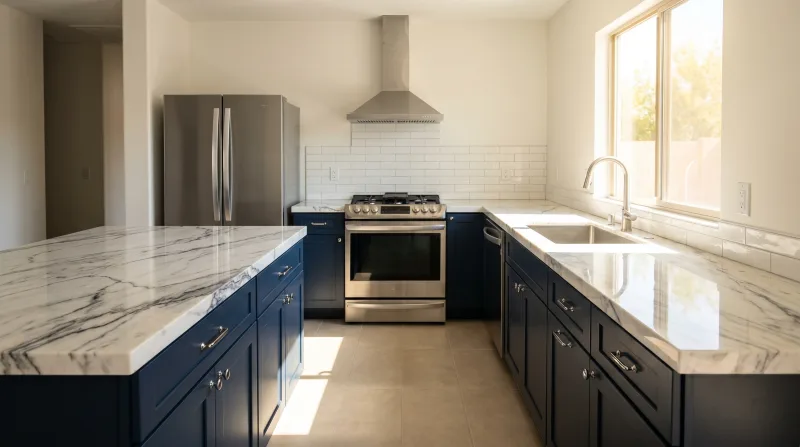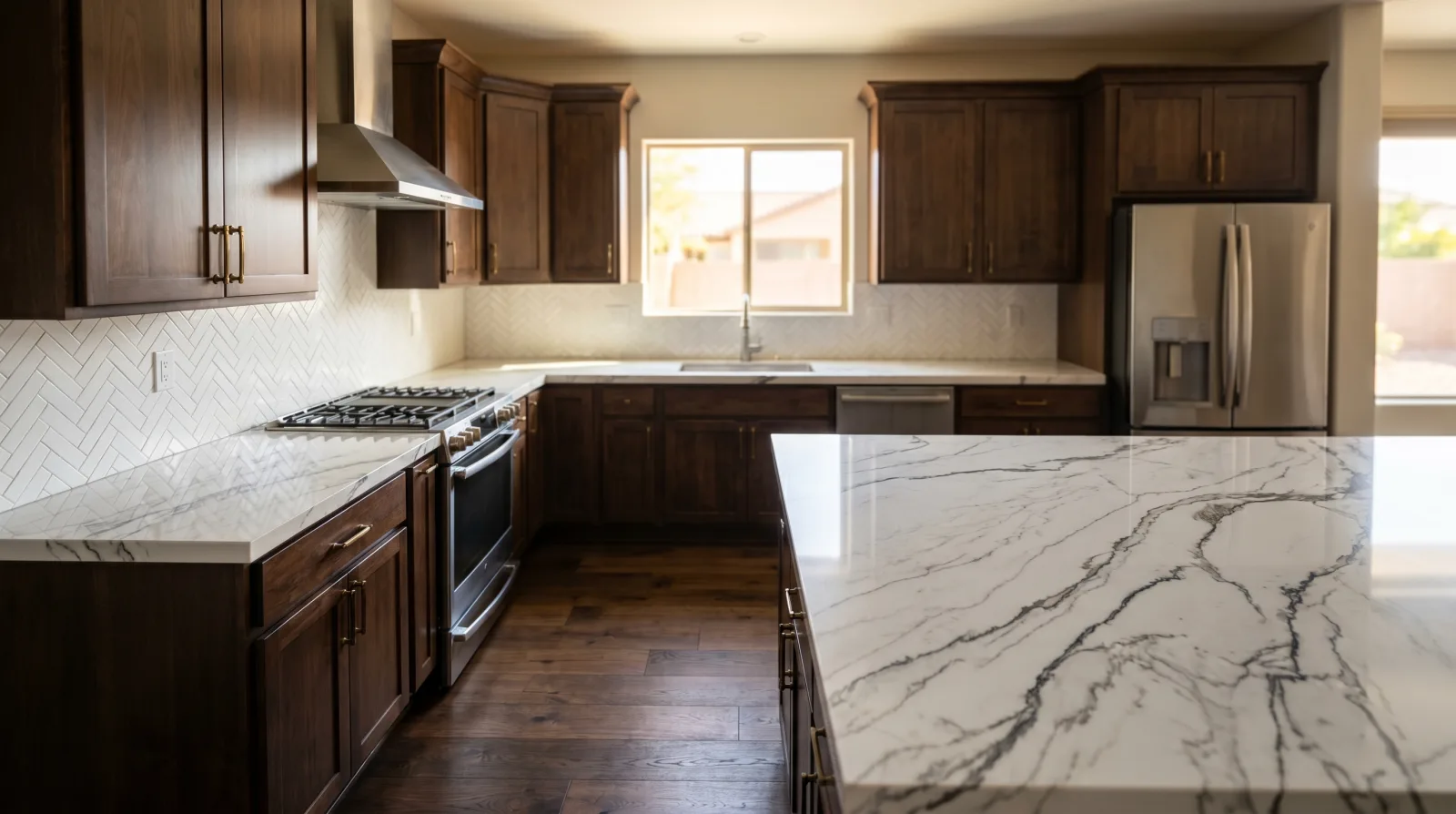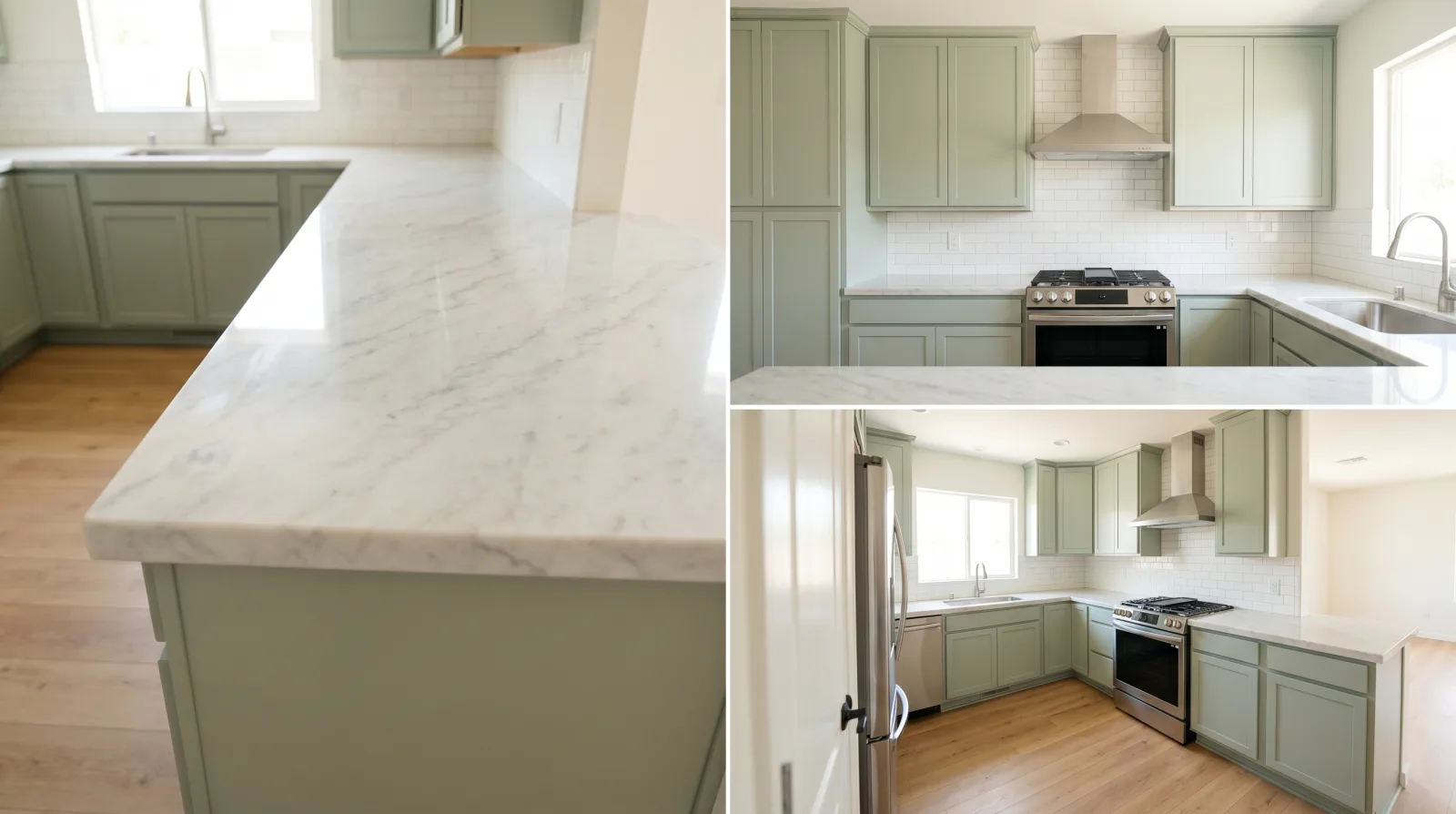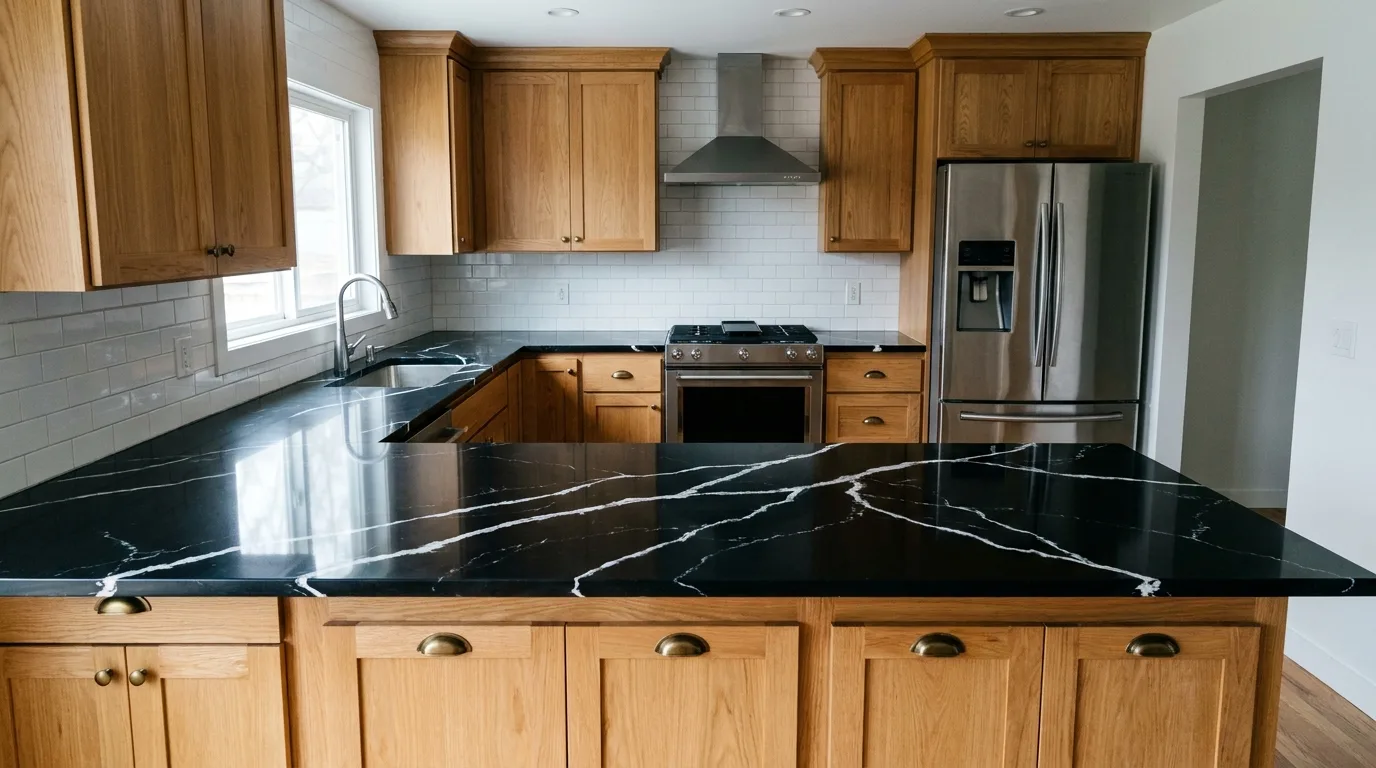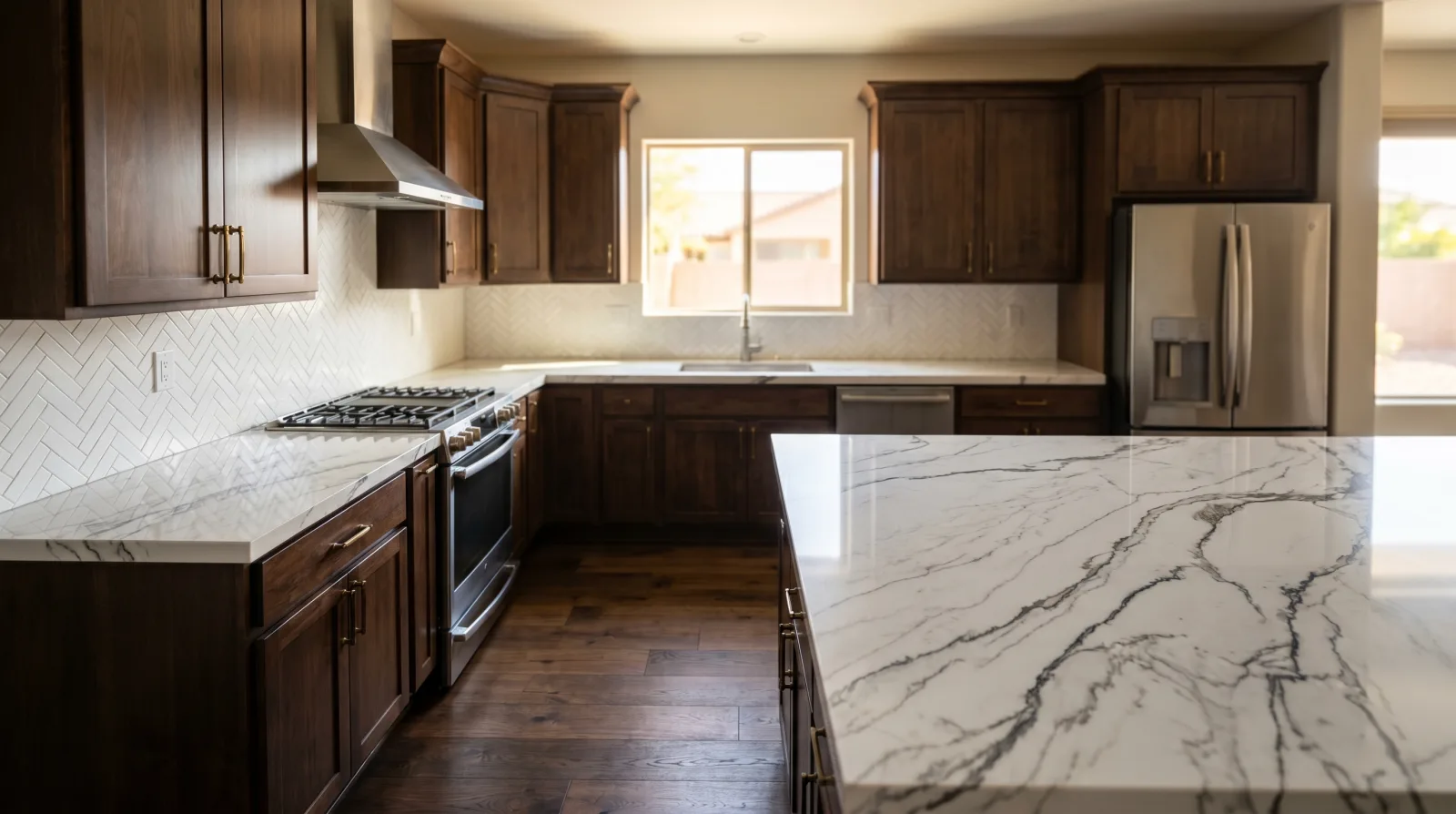
If you're comparing lab stone vs granite countertops, you've already done the hard part — narrowing the field. Both are serious choices that transform a kitchen from dated to design-forward. But they differ dramatically on cost, installation process, and long-term commitment. I've installed both across hundreds of Phoenix-area homes, and this guide gives you the unfiltered version of what I tell every homeowner who walks through our door.
The short answer: lab stone wins on price, installation speed, and maintenance simplicity. Granite wins on natural variation, proven resale track record, and the kind of one-of-a-kind slab character you simply cannot engineer. The right choice depends on what you actually value — and how much of your renovation budget you want to spend on the countertop alone.
Let's run the full comparison.
| Material | Cost / sq ft | Total Kitchen Cost | Install Time | Maintenance | Sealing Required | Durability (1–10) | Best For |
|---|---|---|---|---|---|---|---|
| Lab Stone ✓ | Flat per room | $999 per kitchen | 1–2 days | Wipe clean | No (sealed at install) | 8 | Budget-smart renovations, rentals, flips, in-home pours |
| Granite | $55–$175 | $4,500–$14,000+ | 3–7 days | Annual sealing | Yes (every 1–3 yrs) | 8 | Custom builds, natural stone purists, high-end spec homes |
What Is Lab Stone and How Does It Compare to Granite?
Granite is quarried directly from the earth — solid igneous rock cut into slabs, typically 3/4 to 1-1/4 inches thick, then polished and installed on a base cabinet. Each slab is unique. The veining, speckle pattern, and color variation in a piece of Kashmir White or Ubatuba Black exist nowhere else on the planet. That's granite's biggest selling point: authenticity at a geological scale.
Lab stone, by contrast, is a poured surface renovation. We apply a high-performance epoxy composite directly over your existing countertop substrate — whether that's laminate, tile, concrete, or old granite — using proprietary stone-replicating techniques developed for residential renovation. The result is a seamless, thick-coat surface that mimics the appearance of natural stone with 7+ Mohs hardness and chemical resistance that outperforms granite in some categories.
Here's the critical distinction most comparison articles miss: lab stone isn't a replacement material you buy at a slab yard. It's an in-home service. You're not paying for material plus demolition plus fabrication plus installation plus disposal. You're paying for a crew to transform what's already there — usually in a single day.
That's what makes the cost difference so stark. When you rip out granite countertops, you're paying a fabricator to template your kitchen, cut slabs to fit, transport 400–600 lbs of stone per slab, and install them using a crew. With lab stone, the existing surface stays. The crew arrives with equipment, applies the base, builds the stone pattern layer by layer, seals, and leaves. No dumpster. No dust from cutting. No week-long kitchen shutdown.
Curious what your kitchen would cost in lab stone? Get an instant estimate — no commitment, no sales call.
Configure & Price Your Kitchen →Which Costs Less: Lab Stone or Granite?
Lab stone is priced per room, not per square foot. A kitchen is $999 all-in — material, labor, sealing and the curing period — whatever its size or layout. A half bathroom is $299 and a full bathroom is $499.
Granite is more expensive at every tier. Entry-level granite (Level 1 domestic stone like Uba Tuba or Giallo Ornamental) runs $55–$85/sqft installed. Mid-grade stones like Bianco Romano or Black Galaxy run $85–$120/sqft. Premium exotic granites — Brazilian Blue Bahia, Norwegian Emerald Pearl, Leathered Taj Mahal — push $150–$175/sqft or higher when you factor in rarity markups. The same 55-square-foot Phoenix kitchen costs $4,500–$6,500 for basic granite and $8,500–$12,000+ for a premium exotic.
Where does that gap come from? Granite pricing is built on a supply chain with real friction costs:
- Quarrying and import fees — Most exotic granite is quarried in Brazil, India, or Norway, then shipped to domestic slab yards.
- Slab yard markup — Typically 30–50% on top of wholesale.
- Fabrication — Template, cut, polish, edge profile: $20–$35/sqft on top of slab cost.
- Installation labor — Granite slabs weigh 15–20 lbs per square foot. Moving and setting them requires 2–3 person crews minimum.
- Demo and disposal — Removing existing countertops runs $300–$600 in Phoenix depending on material and footage.
Lab stone has none of those friction costs. There's no slab yard. No import. No heavy lifting. No demo. You're paying for skilled labor and material applied on-site, and that labor efficiency is where the savings come from.
One important caveat: if your existing countertop substrate is in poor condition — major water damage, unstable substrate, severe delamination — there will be prep costs before lab stone can be applied. We assess this in every quote. In most Phoenix homes with countertops installed within the last 20 years, the substrate is solid and requires no remediation.
How Do Lab Stone and Granite Compare on Durability?
Both materials score an 8 out of 10 in practical kitchen durability. Here's what that looks like in real terms:
Hardness: Granite registers 6–7 on the Mohs hardness scale. Lab stone, once fully cured, achieves 7+ due to the epoxy matrix and topcoat hardener. Both will resist scratching from normal kitchen use — knives, pans, ceramic dishes. Neither will scratch from anything you'd typically encounter in daily cooking.
Heat resistance: Granite can handle brief contact with hot pans without damage. Lab stone handles heat up to 400°F continuously, though we recommend trivets for both materials — not because the surface will fail, but because thermal cycling causes micro-stress in any countertop material over time.
Impact resistance: This is where granite has a slight edge. A heavy cast iron skillet dropped from counter height can chip a granite edge, but the slab itself is essentially indestructible. Lab stone is more impact-resistant than granite in the sense that it has some flex — the epoxy base absorbs impact energy rather than transferring it to the substrate. The tradeoff is that extreme impact on a thin coat section can crack the finish in ways that are more visible than a chip in granite's crystalline surface.
Chemical resistance: Lab stone wins here clearly. Granite is porous and will absorb acidic liquids — citrus juice, wine, tomato sauce — if the sealer has degraded. Lab stone's sealed epoxy surface is impervious to acids and alkalis within the pH range you'd encounter in any kitchen. Spill red wine on unsealed granite and you have a permanent stain. Spill it on lab stone and you wipe it up.
Long-term wear: Granite is a 20–30 year surface with proper maintenance. Lab stone, installed correctly with a professional-grade topcoat, carries a 10–15 year performance lifespan before any resurfacing is warranted. If you're in a home for the long haul and want to install a surface once and never think about it again, granite has the track record advantage.
What About Maintenance and Sealing?
This is one of the clearest wins for lab stone, and homeowners consistently tell me it factors heavily into their final decision once they understand what granite maintenance actually requires.
Granite maintenance reality: Every granite countertop needs sealing. The frequency depends on the stone's porosity (darker granites tend to be less porous; lighter granites like White Ice or Colonial White are highly porous), your cleaning habits, and what sealers were used at installation. The standard recommendation is re-seal annually. Many homeowners don't — which is why I've walked into Phoenix kitchens with beautiful granite that's permanently stained with coffee rings and oil shadows around the cooktop. To test whether your granite needs sealing, drop water on it. If it beads, you're fine. If it absorbs, seal immediately.
Resealing granite yourself costs $30–$60 for a quality penetrating sealer and takes 45 minutes. Having it professionally sealed runs $150–$300. It's not a catastrophic burden, but it's an ongoing commitment most homeowners underestimate when they buy granite.
Lab stone maintenance reality: Wipe with mild dish soap and water. That's it. The factory-grade topcoat applied during installation creates a non-porous, stain-resistant barrier that doesn't degrade under normal kitchen use. There's no annual sealing requirement. If the surface is scratched deeply — which takes significant force — a professional can spot-refinish the affected area without replacing the entire countertop. For routine maintenance, lab stone requires less attention than laminate.
What both materials share: avoid bleach-based cleaners, highly abrasive scrubbers, and leaving standing acidic liquids for extended periods (though lab stone tolerates this far better than granite). Neither surface benefits from being used as a cutting board, and both look significantly better with consistent day-to-day care.
Which Looks Better: Lab Stone or Granite?
Honest answer: it depends on the kitchen, and the gap is smaller than granite purists want to admit.
Natural granite has character that no engineered surface fully replicates. A slab of Azul Bahia — deep blue with golden quartz inclusions that catch light differently across the day — is genuinely extraordinary. A book-matched Emerald Pearl kitchen island is an art object. If you're designing around a statement slab and your countertop is the centerpiece of the room, natural granite wins the aesthetic argument without debate.
Lab stone's strength is in versatility and consistency. We can replicate any look — Carrara marble veining, Calacatta gold movement, Nero Marquina dramatic black-and-white — across an entire kitchen with no seam variation and no mismatched slab lots. If you want a pure white Calacatta look throughout your kitchen with perfect uniformity, lab stone delivers that more reliably than trying to match multiple granite slabs from the same lot at a slab yard. The bolder end of that range works the same way — arabescato over burgundy cabinets in McCormick Ranch is a high-contrast pairing that would be hard to source as a matched slab set.
In the Phoenix market, where open-concept kitchens often require 80–100+ square feet of counter coverage, the seam management question becomes real. Large granite kitchens always have visible seams — fabricators try to place them strategically, but they're there. Lab stone is seamless by nature, which creates a cleaner, more architectural look in modern kitchens with long runs of continuous counter.
The other visual factor: edges. Granite edge profiles — ogee, waterfall, dupont, beveled — are applied during fabrication and add $10–$25 per linear foot to the project. Lab stone edges are built up as part of the application process and can be shaped to match essentially any profile. Neither material has a categorical edge advantage; it comes down to execution quality.
If you would rather judge that by eye than by argument, the before and after photos put thirteen Phoenix counters in both frames — the same room, the same light, the old surface and the new one.
How Does Installation Differ?
This is where the practical reality of granite versus lab stone hits hardest for most Phoenix homeowners.
Granite installation timeline:
- Day 1: Fabricator templates your kitchen (90 min–2 hrs). This requires your base cabinets to be fully installed, plumbing roughed in, and appliances in place.
- Days 1–5: Slab is cut, edged, polished, and fabricated at the shop. You have no countertops during this window.
- Day 6–7: Installation day. Crew arrives with slabs, sets them on cabinets, cuts sink opening on-site, caulks seams, and secures. Full day process.
- Day 7: Plumber returns to connect sink and faucet. Caulk cure time: 24 hrs before use.
Total kitchen downtime: 5–7 days minimum. During that window, you have no countertops, no sink, and no functional kitchen. For a family of four in a Phoenix summer, this is a real inconvenience — not a dealbreaker, but something to plan for.
Lab stone installation timeline:
- Day 1 (morning): Crew arrives, removes sink and faucet, preps and abrades existing surface, applies base coats.
- Day 1 (afternoon): Stone pattern application, vein work, initial cure begins.
- Day 2: Final topcoat applied, sink reinstalled, edges finished.
- 48 hrs after final coat: Full use approved.
Total kitchen downtime: 48–72 hours. Most homeowners are washing dishes in their kitchen by day three. There's no template appointment, no slab yard visit, no waiting on fabrication. You schedule the crew, they show up, and the transformation happens in your home.
One granite advantage: if you're building new construction or doing a full kitchen gut renovation where cabinets are being replaced anyway, the granite timeline integrates naturally. You template after cabinets are set, fabrication happens during other finish work, and installation lands at exactly the right point in the construction schedule. In a full remodel, granite's lead time is rarely a problem. It's renovation-only projects — where you want updated countertops without touching anything else — where lab stone's speed becomes genuinely valuable.
| Lab Stone — Pros | Lab Stone — Cons | |
|---|---|---|
| Cost | $999 flat per kitchen; no demo, no fabrication fees | Price varies by surface prep complexity |
| Installation | 1–2 days, no kitchen tear-out | Requires existing stable substrate |
| Maintenance | No annual sealing; wipe-and-go | Professional refinish needed for deep scratches |
| Appearance | Seamless; consistent pattern across large surfaces | No true natural variation; engineered look |
| Durability | 7+ Mohs; chemical-resistant; impact-absorbing | 10–15 yr lifespan vs granite's 20–30 yrs |
| Versatility | Works over existing laminate, tile, old granite | Cannot be installed on structurally compromised substrate |
| Granite — Pros | Granite — Cons | |
|---|---|---|
| Cost | Wide price range; entry-level slabs affordable | Premium exotics $150+/sqft; total cost often $8K–$14K+ |
| Installation | Integrates well into full remodel timeline | 5–7 day kitchen downtime; heavy logistics |
| Maintenance | Standard sealers readily available | Annual re-sealing required; porous if neglected |
| Appearance | Unique, one-of-a-kind slab character; authentic natural stone | Visible seams on large kitchens; lot-matching challenges |
| Durability | 20–30 year surface; proven track record | Porous without sealer; chips on edges from impact |
| Versatility | Wide range of exotic options globally sourced | Requires full demo of existing countertops |
Which Is Better for Resale Value?
Both materials add value. The question is which adds more value per dollar invested — and that's where lab stone has a compelling story.
Granite countertops have a proven resale reputation. Realtors in Phoenix consistently cite granite as a buyer expectation in the $450K–$650K price range, and listings that specifically mention granite countertops generate more clicks and shorter days on market than comparable homes without them. If you're selling a home in a neighborhood where granite is the standard, installing granite brings you to market parity.
But here's the ROI math that often surprises homeowners: if granite costs you $9,000 and adds $8,000–$10,000 in perceived value, your return is roughly 90–110%. If lab stone costs you $3,800 and buyers perceive the kitchen as updated and high-quality — which they do, consistently — you've achieved the same buyer outcome at 42% of the spend. The incremental value add may be similar, but the investment required is dramatically different.
Where granite maintains a clear resale edge: luxury price points above $900K and custom builds where buyers expect to see exotic natural stone. In those markets, lab stone reads as a budget choice even when executed beautifully. The materials comparison in a luxury buyer's mind isn't always rational, but it's real. If you're staging a $1.2M Arcadia spec home, invest in the granite.
For the vast majority of Phoenix-area homes — the $300K–$750K resale market that makes up most of our client base — lab stone delivers resale value at a fraction of the granite investment. I've had investors renovate rental properties with lab stone at $999 per kitchen and increase rental rates by $200/month. That math works. Granite at $9,000 in the same rental rarely pencils out within a reasonable hold period.
Which Should You Choose?
Here's the framework I give homeowners in our initial consultation:
Choose lab stone if:
- You want updated countertops without a full kitchen renovation
- Your budget is under $6,000 for countertops
- You cannot tolerate a week-long kitchen shutdown
- You're renovating a rental property or investment home
- Your existing substrate is in good condition and you want to keep demo costs zero
- You want a seamless, uniform look across a large kitchen
- Low maintenance is a priority (young kids, busy household, rental tenants)
Choose granite if:
- You're doing a complete kitchen gut renovation with new cabinets
- Natural stone authenticity matters to you and you appreciate geological uniqueness
- You're selling a luxury property above $900K where granite is the market expectation
- You have budget flexibility and want a 25+ year countertop with deep resale credentials
- You've found a specific exotic slab with character that genuinely excites you
The honest truth I've arrived at after hundreds of installations: most homeowners who initially want granite end up with lab stone — not because they compromised, but because when they see the finished result and the cost difference, they can't articulate a reason to have chosen otherwise. The kitchens look great. The surfaces perform. The money saved went somewhere more meaningful — better appliances, a tile backsplash they actually love, or money back in their pocket.
That said, I've also had homeowners who specifically wanted the experience of selecting their own slab at a yard, who wanted the story of where their stone came from, who wanted something irreplaceable. Granite gave them that. It's not the wrong choice — it's a different set of values. Know which set is yours, and the decision becomes obvious.
See also: Kitchen countertops in Phoenix.