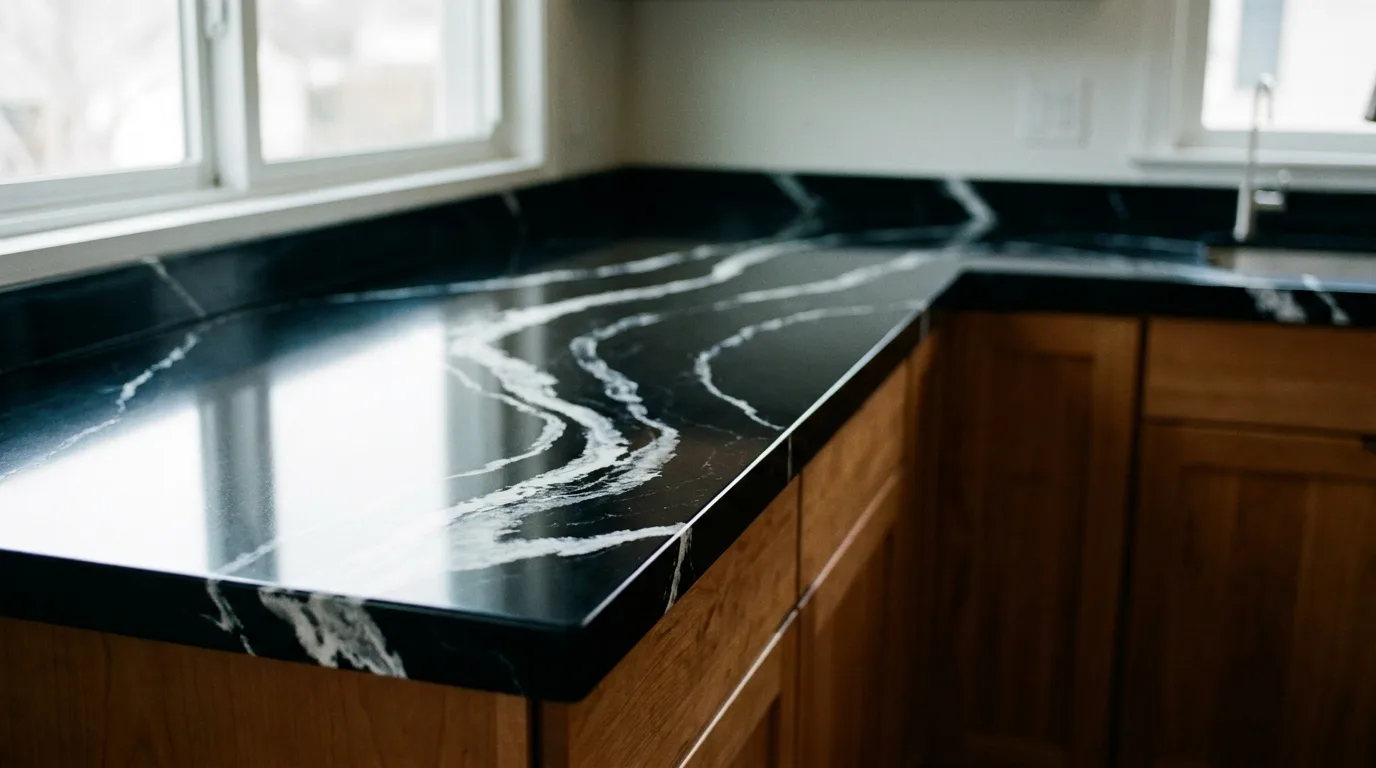
Nero Marquina + Natural Oak
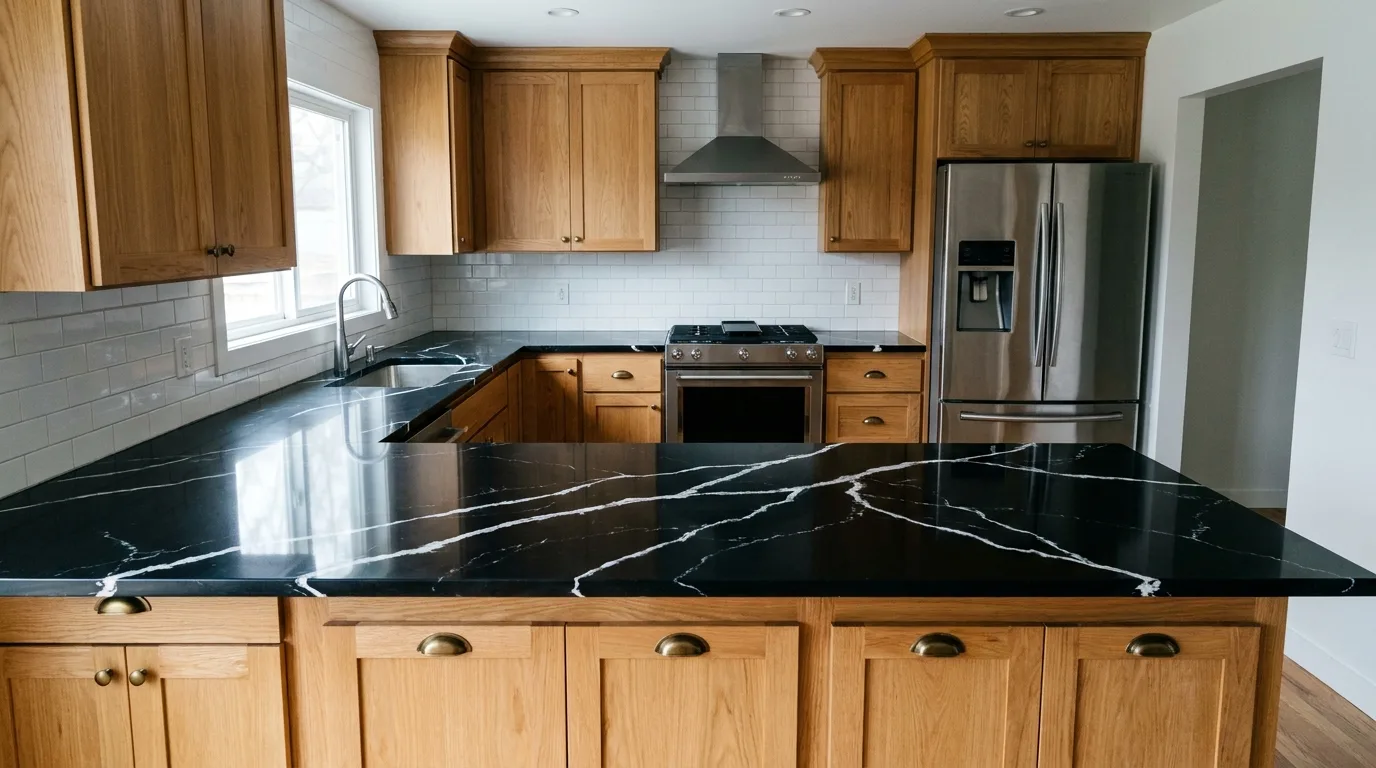
The Vistancia kitchen that finally earns the golf-course view. High-contrast, architectural, unmistakably yours — poured over your existing counters in 8 hours.
Vistancia deserves better kitchens
Trilogy 55+. Blackstone Country Club. Sunrise Mountain views. Two championship golf courses. The homes are spec'd at country-club tier — but the kitchens default to the same Pulte and Shea playbook: cream cabinets, beige granite, white tile.
Every Vistancia kitchen photo on the MLS is interchangeable. This one won't be.
Nero Marquina is the most architecturally serious counter you can install — it reads “designed” instantly.
Tuxedo marble, reimagined
Deep jet-black base with bold white pigment veining — hand-poured, painterly, never crystalline. Mirror-glossy finish that catches every chandelier and every golf-course window.
Over warm natural white oak shaker cabinets with straight grain showing through, satin-sealed, no stain. Antique brass cup-pulls, herringbone backsplash, schoolhouse pendants, rift-cut oak floors. The whole kitchen reads architectural and intentional.
Real vs. lab
Spanish-quarried Nero Marquina runs $130–200/sqft installed. A typical Vistancia kitchen — 70–90 linear feet with island and butler's pantry — costs $11,000–$21,000 for stone alone. Real white oak cabinetry adds another $20,000–$45,000.
We pour Nero Marquina lab stone over your existing counters. Wall-runs only — no waterfalls. Each piece is unique. Hyper-glossy mirror finish. Bonds permanently. Heat- and stain-resistant. Harder than the surface underneath. 8 hours, done.
The kitchen above? $999.
Build-A-Counter Lab StoneDark stone and a west-facing kitchen
Vistancia sits in far north Peoria, and like most of the newer master-planned communities out there, the homes were designed to make the most of the view — which in practice means large windows, open-plan great rooms, and kitchens that get a great deal more direct light than the closed-off kitchens of older Valley housing stock. If your island faces west, it spends several hours a day in genuine desert afternoon sun.
That matters more for a black counter than a white one, for two reasons.
Heat. A dark surface in direct sun absorbs more energy and runs hotter than a light one. This is true of any countertop material — granite, quartz, lab stone — and it is not a defect, it is physics. The practical consequence is small but real: a west-facing dark island can be noticeably warm to lean on at four in the afternoon in July. Most people never think about it. Some people, once they notice, cannot stop noticing. Worth knowing before rather than after.
UV. This one separates materials sharply, and it is the reason we are comfortable putting a dark finish in a sun-flooded room. Engineered quartz is bound with resins that are not UV-stable, which is why manufacturers routinely exclude direct-sun and outdoor applications from quartz warranties — over years, sustained UV exposure can yellow or shift the colour of the binder, and on a dark stone that shift shows as a patchy fade exactly where the sun lands. Lab stone uses UV-stabilised pigment sealed beneath the topcoat, which is a different construction addressing that specific failure.
If you are weighing a dark counter for a bright room and want the full material-by-material comparison, our Arizona climate guide goes through each one in detail.
Why Nero Marquina against natural oak
The pairing is doing something fairly specific. Nero Marquina is a black marble look with sharp white veining — high contrast, quite formal, and on its own it can read cold or severe, particularly in a large open room. Natural oak is the corrective. The grain and the warmth pull the formality back down to something liveable, and the effect is closer to a modern desert kitchen than a dark European one.
The white veining is also the functional element, not just decoration. An unrelieved black counter in a big room becomes a visual void — it reads as a hole in the middle of the floor plan. Veining breaks the mass and gives the eye structure, which is precisely why solid-black counters tend to work better on small perimeter runs than on large islands.
Because every pour is veined by hand rather than printed, the pattern on your island is drawn for your island — its actual length, its actual seams. That is the part that is difficult to fake: printed patterns repeat, and on a long run the repeat is visible once you know to look for it.
Common questions — north Peoria kitchens
Can you resurface an island and the perimeter in the same day?
Yes, that is a standard single-day kitchen for us — the 8–12 hour window covers both. What extends
a job is unusual prep on the existing surface, not the amount of countertop.
Will a black counter show crumbs and dust more?
Yes. Honestly, yes. Dark glossy surfaces show light-coloured dust, crumbs and water marks more
readily than mid-tone or patterned ones, and in a desert climate with dust in the air that is a
real daily consideration rather than a theoretical one. The veining helps — it breaks up the
field so small debris is less conspicuous than it would be on solid black — but anyone telling you
a black gloss counter hides mess is selling. It is a genuine trade for the look.
Does the finish scratch from normal use?
The cured surface is harder than the substrate underneath it. Normal kitchen use is fine. Use a
board rather than cutting directly on any counter, of any material — that advice is not specific
to us.
Do you serve Vistancia and north Peoria?
Yes, 85383 and the surrounding north Valley including Surprise, Anthem, New River and Cave
Creek.
For a softer take on the dark-counter idea, the panda marble kitchen in Sun Lakes uses a lighter ground with heavy black veining, and the Thassos and matte black kitchen in Roosevelt Row inverts the contrast entirely.
Get This Look — From $999
8-hour install. No demolition. Vistancia & north Peoria.
Start My Free Quote Call (602) 507-2683