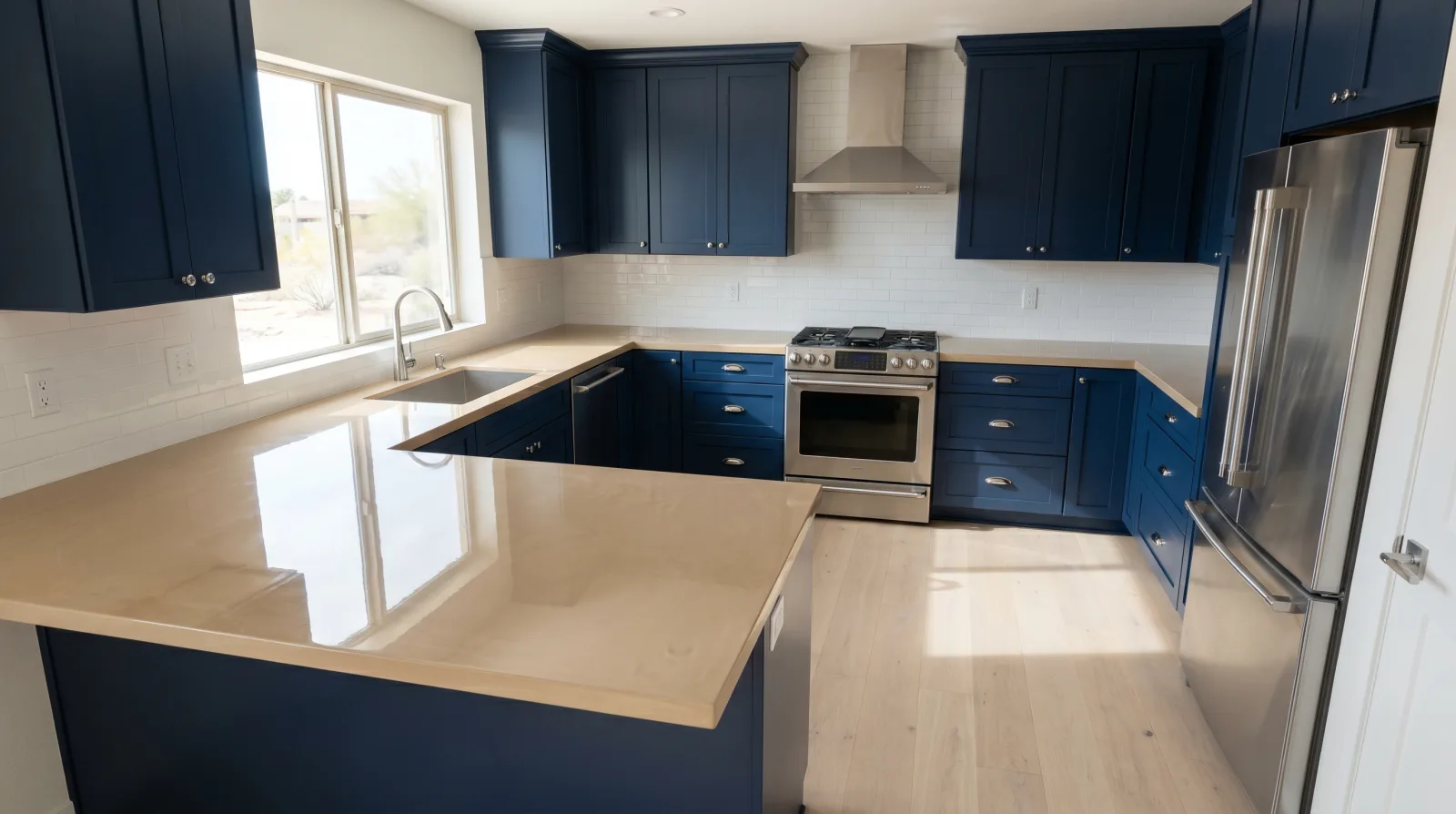
If you are pricing new kitchen counters in the Phoenix metro, you are making two decisions at once: which material, and whether to replace the countertop at all. Most homeowners here start at a slab yard, fall for something beautiful, get the quote, and then start looking for another way. This page covers both decisions — what actually survives Arizona conditions, what it costs in this market, and where resurfacing makes more sense than replacement.
What do kitchen countertops cost in Phoenix?
Traditional slab replacement in a Phoenix kitchen generally runs $5,000 to $15,000 installed. The spread comes down to material grade and layout size — a galley kitchen with 25 square feet of counter is a different project than an open-plan kitchen with a waterfall island.
That number is only part of it. Slab replacement also means demolition, a plumbing disconnect and reconnect, possible backsplash repair, and a 3 to 6 week lead time while the slab is sourced, templated, and fabricated. For most of that stretch your kitchen is not a working kitchen.
Size is what drives a slab quote, so it is worth knowing your own numbers before you ask for one — standard kitchen countertop dimensions covers depth, overhang and height, and what to measure in a Phoenix tract kitchen.
A lab stone kitchen is $999 regardless of size, and a typical whole project — kitchen plus a bath or two — runs around $1,900. The reason it costs less is structural, not a discount: nothing is quarried, cut, shipped, or torn out. The surface is poured directly over the countertops you already have.
Put another way — resurfaced kitchen counters carry no fabrication, freight, or demolition line items at all. On a slab quote those three categories routinely account for more than half the invoice, which is why the gap between the two numbers is so much wider than the difference in material cost would suggest.
| Phoenix kitchen | Slab replacement | Lab stone resurfacing |
|---|---|---|
| Typical installed cost | $5,000–$15,000 | $999, any size or layout |
| Kitchen plus a bath or two | Priced per surface, so it compounds | Around $1,900 — baths from $299 |
| Lead time before anyone starts | 3–6 weeks to source, template and fabricate | None — the material is poured on site |
| Time your kitchen is out of service | Days, plus the weeks of waiting | 8–12 hours |
| Demolition and haul-away | Yes — the old tops come out | None — they become the substrate |
| Plumbing disconnect | Yes | No |
| Backsplash and drywall repair | Common where the old tops pull away | Not required |
| Seams | At every slab join | One continuous poured surface |
| Ongoing sealing | Granite, marble and quartzite need it | Non-porous — no sealing schedule |
The two columns are not the same purchase. A slab quote buys quarried stone and the labour to cut, ship and fit it; resurfacing buys a surface poured over what is already bolted to your cabinets. That is the whole reason the numbers sit so far apart — it is not a cheaper grade of the same thing.
Which countertop material handles Arizona best?
Phoenix is unusual enough that national buying guides are close to useless here. The threats are heat, UV, thermal cycling, and hard water — not moisture.
Granite
Granite is the strongest natural stone choice for an Arizona kitchen. It tolerates heat, and its crystalline structure does not degrade under UV the way polymers do. The tradeoff is porosity: it needs sealing, and the sealer breaks down faster here than in milder climates. Light-colored granites also show calcium etching from Phoenix hard water near the sink.
Engineered quartz
Quartz is the most popular countertop material in the country and the one most often mismatched to this climate. The resin binders that hold it together are not UV-stable. In a kitchen with west-facing windows, white and light-gray quartz can yellow within a few years. Every major quartz manufacturer voids warranty for outdoor use, which tells you what direct sun does to it. Indoors with limited light, quartz is fine.
Marble
Marble is soft and porous, and Phoenix water runs roughly 350–500 ppm total dissolved solids. Etching around the sink shows up in months, not years. If you want the marble look with better performance, quartzite or a marble-pattern lab stone gets you there.
Quartzite
Harder than granite, more UV-stable than engineered quartz, and genuinely beautiful. Still porous, still needs sealing, and still priced as a premium natural stone. Worth it if natural stone is non-negotiable.
Lab stone
Lab stone is the poured surface we install. It matters here for three specific reasons: the polymer base has flex, so daily thermal cycling between a 68°F air-conditioned interior and a sun-heated surface does not accumulate as micro-fractures; the topcoat is UV-stabilized, so the color you pick is the color you keep; and because it is poured as one continuous surface, there are no seams or grout lines for monsoon humidity and hard water to work into.
For a fuller material-by-material breakdown, see our guide to the best countertops for the Arizona climate and our lab stone vs granite comparison.
How resurfacing works
Lab stone bonds molecularly to the substrate underneath — laminate, tile, granite, or cultured marble. The process is four steps: prep the existing surface, pour and spread the lab stone, flame cure it, then finish to gloss or matte.
A typical kitchen is done in 8 to 12 hours. No cabinets come out. No plumbing is disconnected for weeks. No dumpster in the driveway. If your cabinets and layout still work and it is the countertop that dates the room, replacement is solving a problem you do not have.
Where resurfacing is not the answer: if your counters are structurally failing, if the cabinet boxes underneath are water-damaged, or if you are changing the actual footprint of the kitchen. In those cases you are doing construction, and a new slab makes sense.
Can you change the color of granite countertops?
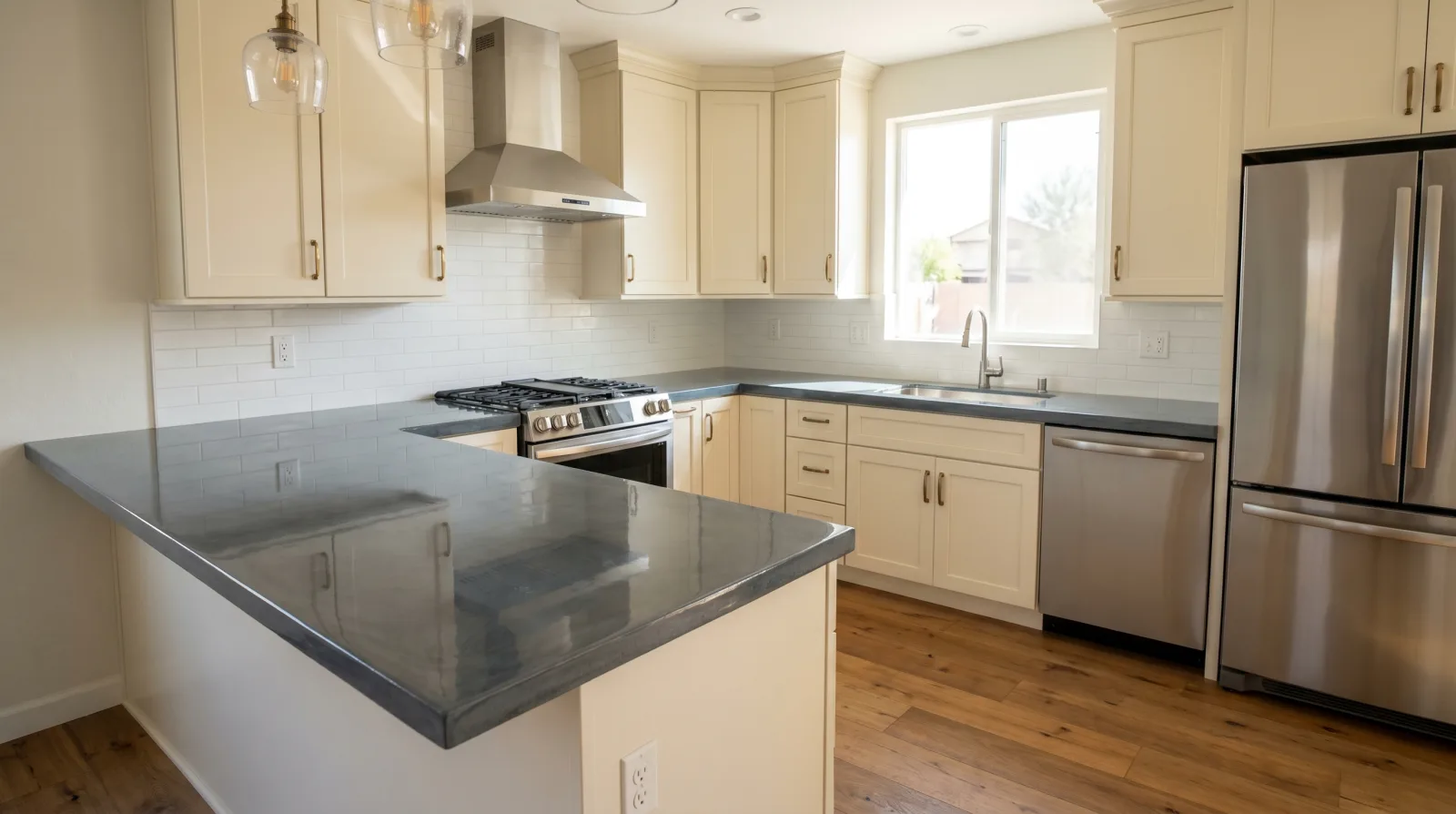
Yes — and in this market it is one of the most common reasons people call. The granite itself is usually fine. Builder-grade speckled granite went into an enormous number of Valley tract homes, it is structurally sound two decades later, and the thing that dates the kitchen is the color and the busy pattern, not the stone's condition. Tearing out a perfectly good top to fix how it looks is an expensive way to solve a visual problem.
Lab stone is poured straight over it. The granite stays exactly where it is and becomes the substrate, which is also why the job does not need demolition, a dumpster, or the sink out of service for a week.
What changing the surface actually fixes
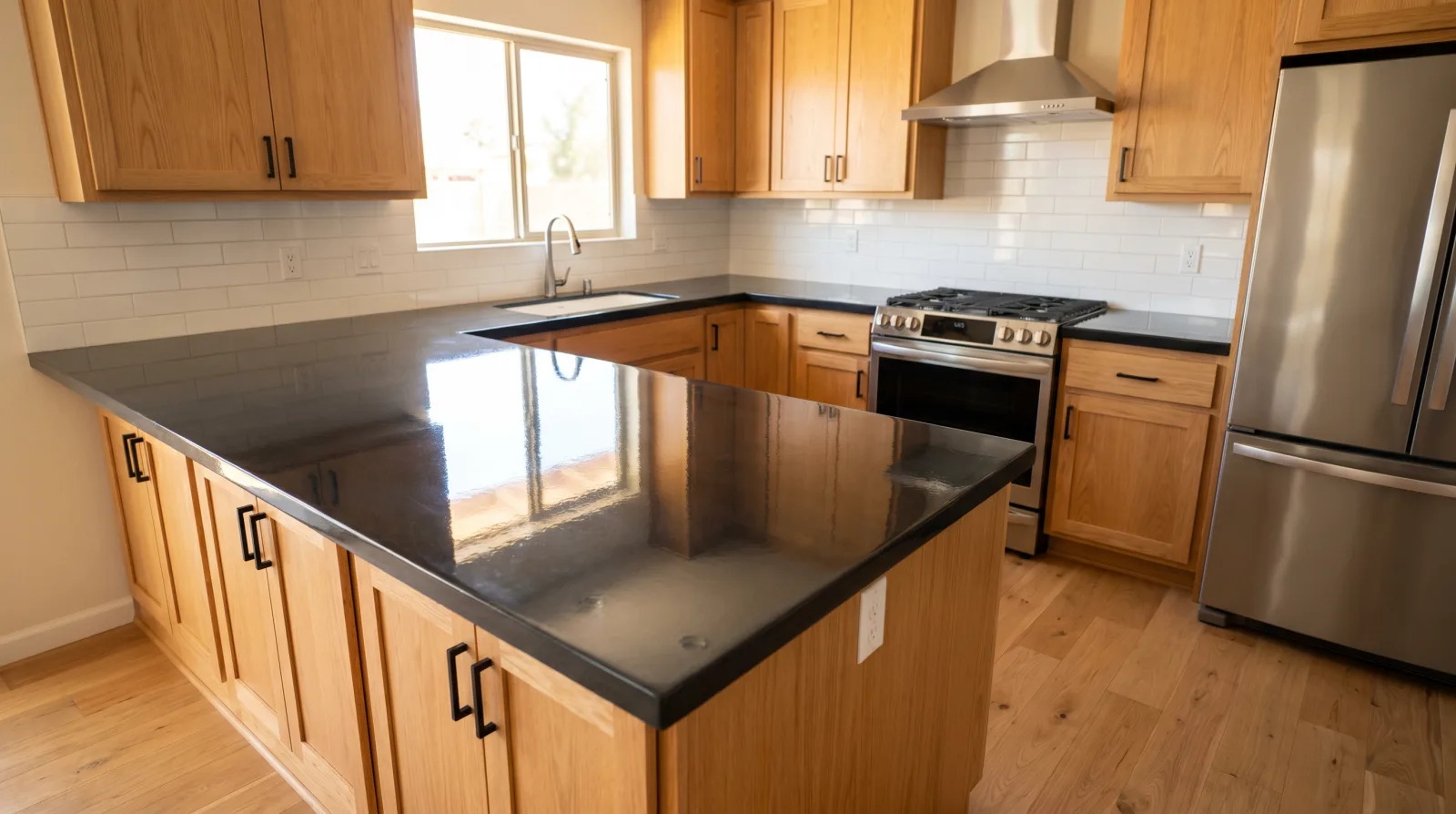
The color and the pattern, obviously. Less obviously: the seams. A granite kitchen is assembled from cut pieces, and the joins collect grime and show wear first. A poured surface has none, so the counter reads as one object. And because the finished surface is non-porous, the sealing routine granite needs in this climate simply ends — there is nothing left open for hard water to work into.
When to keep the granite as it is
If you like the stone and the only real complaint is dullness or water spotting near the sink, you do not need a new surface — you need maintenance. Our guide to sealing and caring for granite and marble in Phoenix covers what to do and how often, including how to tell etching from staining from mineral scale. Resurfacing is the answer when you want the counter to look like a different counter, not when you want the one you have looking after.
It is also not the answer if the top is cracked through, if the cabinet boxes underneath have taken water, or if you are moving the sink or changing the footprint. Those are construction problems, and a new surface poured over them just hides them for a while.
Resurface or replace? A short Phoenix checklist
Most of the decision comes down to whether the thing you dislike is the surface or the kitchen.
Resurfacing is the better call when
- The cabinets and the layout still work and you are not moving anything.
- The existing tops are sound — laminate, tile, granite or cultured marble all take a pour.
- What dates the room is the color, the pattern or the seams.
- You cannot give up a working kitchen for several weeks.
- The budget is a few thousand rather than five figures.
Replace the slab when
- The counters are structurally failing, not just tired.
- The cabinet boxes underneath are water-damaged and have to come out anyway.
- You are changing the footprint — relocating the sink, adding an island, extending a run.
- You specifically want quarried natural stone and the slab itself is the point.
If you are still weighing the materials themselves rather than the method, the lab stone versus granite comparison puts them side by side, and watching an installation stage by stage answers the question most people ask next — what a pour actually involves between prep and topcoat.
Phoenix-area kitchen looks
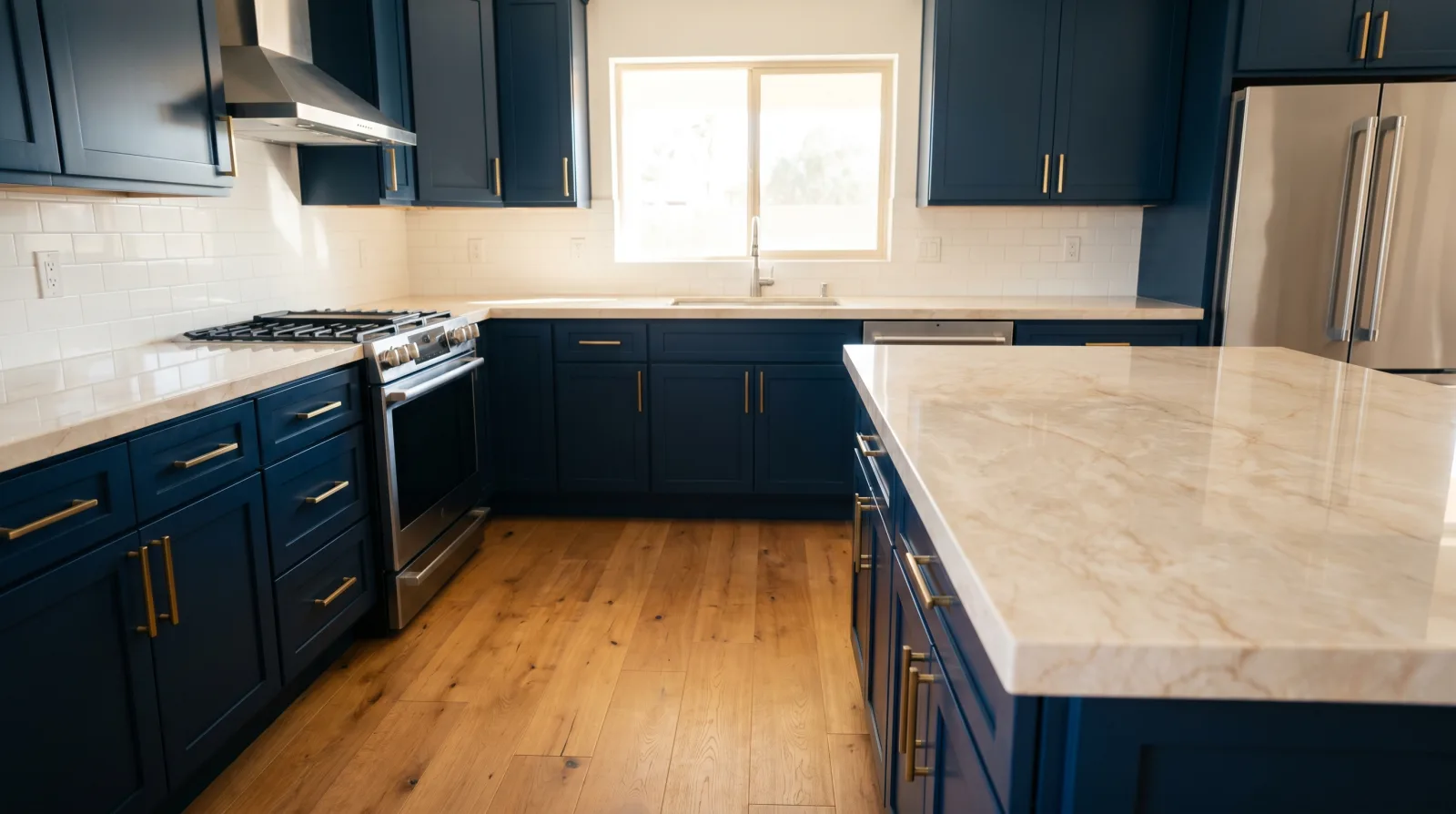
Every look below is a finish we pour, with real pricing. Browse all 39 Phoenix-area looks by city and room.
Where we work
We install across the Phoenix metro, including Phoenix, Scottsdale, Paradise Valley, Arcadia, Biltmore, Tempe, Mesa, Chandler, Gilbert, Queen Creek, Ahwatukee, Glendale, Peoria, Surprise, Sun City, Sun City West, Goodyear, Avondale, Buckeye, Litchfield Park, Verrado, Vistancia, Anthem, New River, Cave Creek, Carefree, Fountain Hills, Apache Junction, Maricopa, Sun Lakes, Eastmark, Las Sendas, Desert Ridge, Moon Valley, McCormick Ranch, Willo Historic, Roosevelt Row, and Wickenburg.
Frequently asked questions
Traditional slab replacement in a Phoenix kitchen typically runs $5,000 to $15,000 installed, depending on material and layout size. A lab stone kitchen is $999 no matter its size or layout, because the surface is poured over your existing countertops rather than replacing them. Most customers do a kitchen plus one or two bathrooms, which brings a typical whole project to around $1,900.
Yes. Lab stone bonds directly to your existing countertop — laminate, tile, granite, or cultured marble. There is no demolition, no plumbing disconnect, and no need to pull your sink cabinet or backsplash. The finished surface is seamless.
Lab stone installs in 8 to 12 hours for a typical kitchen. Traditional slab replacement usually takes 3 to 6 weeks from template to install, because the slab has to be sourced, cut, and fabricated first.
Granite and lab stone handle Arizona conditions best. Engineered quartz is the most UV-vulnerable common material — its resin binders yellow under direct sun, which matters in kitchens with west-facing windows. Lab stone uses UV-stabilized pigment and has enough flex to tolerate daily thermal cycling.
Yes. Lab stone is poured directly over granite, so the granite stays in place and becomes the substrate. There is no demolition and no plumbing disconnect, and the finished surface is one continuous pour with no seams. It changes the color, the pattern and the finish — it does not fix a top that is cracked through or cabinet boxes that have taken water.
Price your Phoenix kitchen
Pick your layout, choose a finish, and get an instant estimate. No sales call required.
Configure & Price My Counter Call (602) 507-2683