Bathroom counters are a smaller surface than a kitchen, which makes replacement feel like it should be cheap. It usually is not. The cost is not in the square footage — it is in pulling the old top, disconnecting and reconnecting plumbing, and paying fabrication minimums on a piece of stone the size of a desk. That is why a vanity you dislike tends to survive three other renovations.
This page covers what bathroom countertops actually cost in the Phoenix metro, which materials survive Arizona hard water, and how resurfacing changes the math.
What bathroom countertops cost in Phoenix
A half bathroom resurface starts at $299 installed; a full bathroom starts at $499. Because the surface is poured over the vanity top you already have, there is no demolition, no fabrication lead time, and no plumbing teardown.
Slab replacement carries costs that scale poorly on small surfaces. Fabricators charge material plus cutting plus install regardless of how modest the piece is, and most have a minimum. A powder room vanity can end up costing a surprising fraction of what a full kitchen would.
If you have several bathrooms, the gap widens. Multiple vanities are frequently completed in a single visit, where slab replacement means repeating the whole disruption in each room.
Resurface vs. replace, on a bathroom-sized surface
| Resurfacing the existing top | New slab | |
|---|---|---|
| Published starting price | $299 half bath · $499 full bath | Quoted per job |
| Demolition | None | Old top and sink removed |
| Plumbing disconnect | Not required | Required |
| Fabrication lead time | None | Typically weeks |
| Fabrication minimum charge | Does not apply | Applies, and hurts most on small tops |
| Time on site | Under a day; multiple vanities often one visit | Repeat visit per room |
| Keeps your existing basin | Yes, if you want to | No |
The asymmetry is the fabrication minimum. On a kitchen it is spread across forty square feet. On a powder-room vanity it is spread across six, which is why a small bathroom is the worst possible surface to buy a slab for and the best one to resurface. The same arithmetic on a kitchen is laid out in countertop resurfacing in Phoenix, and if both rooms are on the list, kitchen countertops in Phoenix covers that side.
Phoenix hard water is the real enemy
The single biggest difference between a bathroom counter here and one in a milder climate is the water. Phoenix runs roughly 350–500 ppm total dissolved solids — hard by any standard.
On porous surfaces, dissolved calcium and magnesium etch the finish. On marble and limestone this is fast and permanent: dull rings around the faucet and basin, often within months rather than years. Unsealed or under-sealed granite shows it too, especially in lighter stones where the contrast is obvious.
Sealing helps, but a bathroom vanity gets wet many times a day, and sealer degrades faster in a hot dry climate. You are signing up for maintenance every six to twelve months to keep ahead of it.
A seamless non-porous surface sidesteps the problem. There is no open pore structure for minerals to bond into, and no seam or grout line at the backsplash for water to work behind. Deposits wipe off instead of etching in.
There is one spot where Phoenix water does its damage first, and it is not the open counter. It is the joint — the caulk or adhesive line where an undermount basin meets the underside of the stone. Water wicks into that line every time the tap runs and then evaporates in a climate that pulls moisture out fast, leaving the dissolved calcium behind. That is why a granite vanity usually fails in the same order every time: a chalky ring at the joint, then discolouration of the caulk itself, then dulling of the stone immediately around the basin, while the stone a foot away still looks new. Resealing the field does nothing about it, because the failure is in a seam, not in the surface. Removing the seam is the only durable fix — which is the case for an integrated basin.
Integrated basin or separate sink?
This is the decision that most changes how a finished bathroom looks.
Separate sink keeps your existing drop-in or undermount basin. The counter is resurfaced around it. It is the simplest path and the right call when the sink itself is in good shape.
Integrated reads as one continuous surface from backsplash through basin, with no rim or seam where the two meet. It looks more custom, and there is no caulk line around the sink to discolor. In a hard-water climate that missing seam is a practical advantage as well as a visual one.
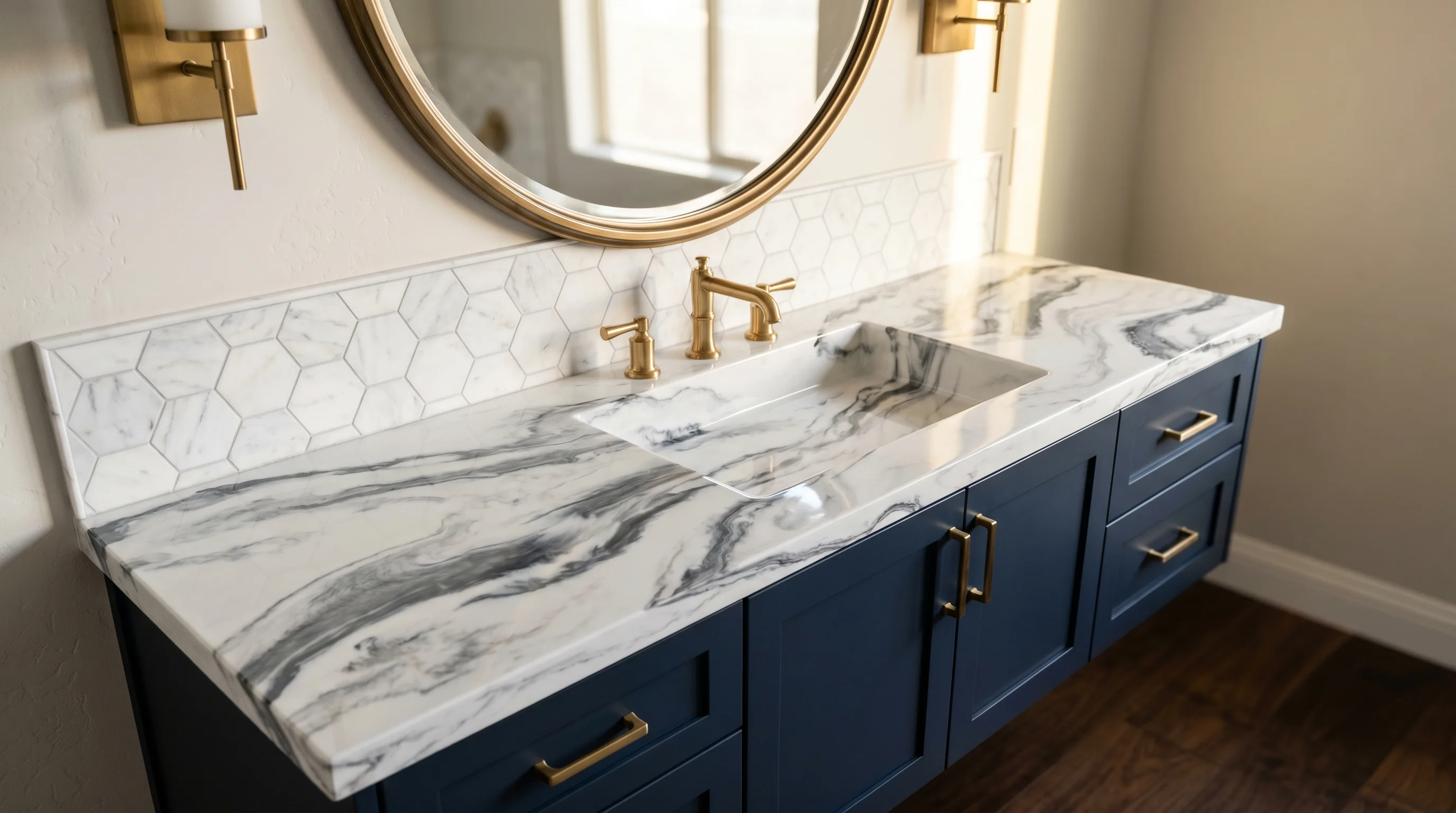
Both options are selectable in the configurator, which prices them separately so you can compare before committing.
Resurfacing around an undermount sink on a granite vanity
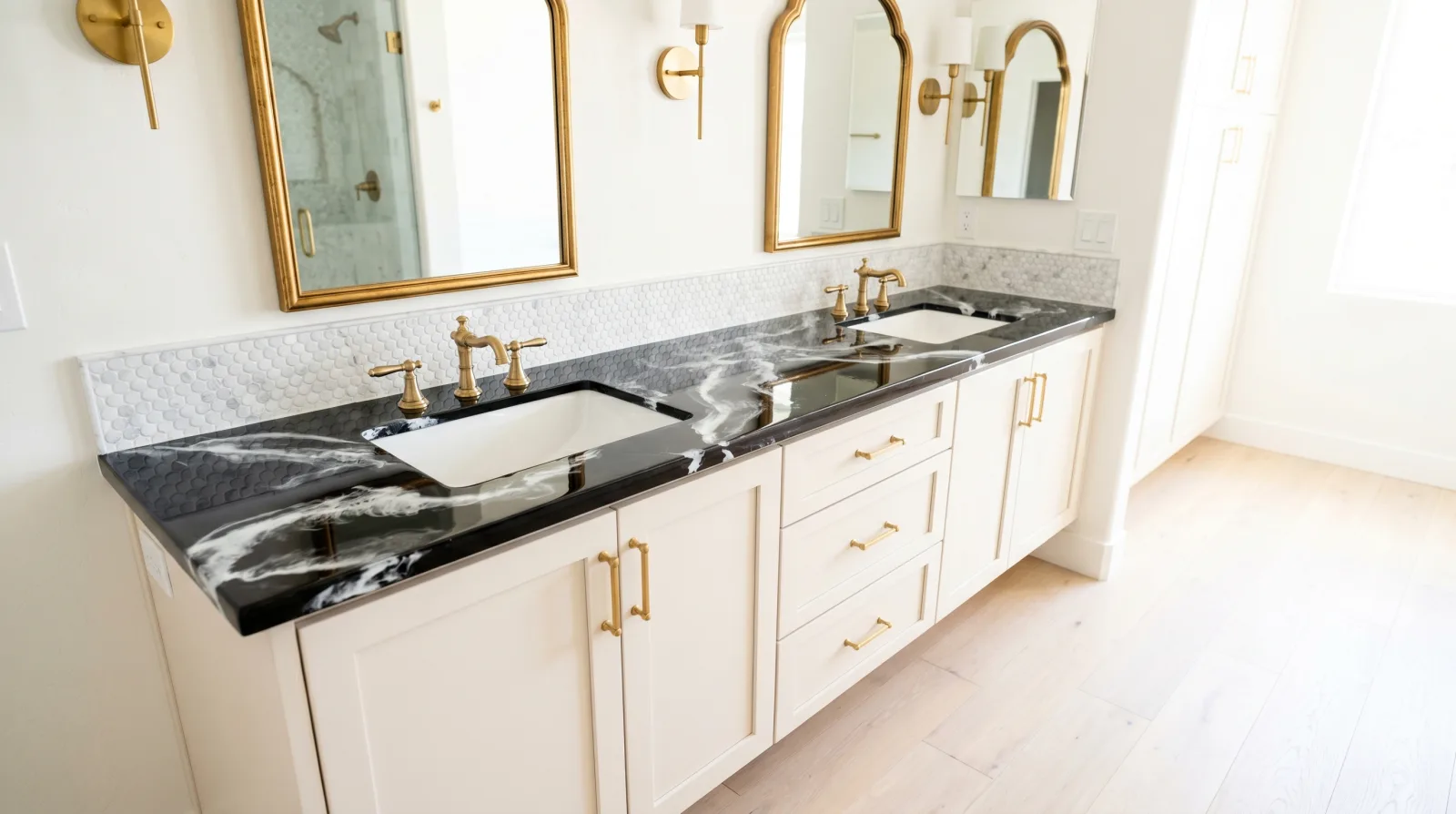
This is the most common bathroom we are called into: a granite or cultured-marble vanity top with an undermount basin, where the stone is sound but the colour is dated and the rim around the basin has gone dull. The sink stays. The slab stays. The surface on top of both is what changes.
It is worth being precise about a word here, because searching for it returns the wrong thing. “Undermount sink granite epoxy” returns sink-stud adhesive — the two-part cartridge epoxy a fabricator uses to glue a basin to the underside of a slab. That is a plumbing consumable. It is not what we do. Lab stone is a poured surface: a coating applied over the existing top and cured into one continuous, non-porous skin. Same word, two unrelated products, and the search results mix them freely.
On an existing undermount basin the joint is the whole job. The original installation left a caulk or adhesive line where stone meets basin, and in Phoenix water that line is where failure starts — see hard water above. A poured surface can be carried to the basin edge and terminated cleanly, or carried through the transition so counter and basin read as one piece with no rim to trap deposits.
Vessel and wash-basin vanities
A wash basin sitting on top of a granite slab is the easiest version of this job, because the basin is not fixed into the surface at all. Lift it, resurface the full slab edge to edge, reset it. No cut-out to work around and no seam at all — the finished top is continuous under the basin, which is exactly where a granite vanity usually shows the most mineral staining, since water pools under the base and sits there.
Three ways to handle the basin
| Approach | Existing basin | Seam at the basin | Best when |
|---|---|---|---|
| Resurface around it | Kept in place | Yes — a finished termination line | The basin is in good condition and you want the shortest, cheapest path |
| Lift, resurface, reset | Kept, removed and replaced | None under the basin | A vessel or wash basin that sits on the surface rather than into it |
| Integrated basin | Replaced by a poured basin | None anywhere | You want no caulk line at all, and the most custom-looking result |
All three start at the same published price — $299 for a half bathroom, $499 for a full bathroom, installed — and all three are selectable in the configurator, which prices them separately.
Which material for an Arizona bathroom?
Bathrooms change the material calculus compared to kitchens. Heat resistance stops mattering — nobody sets a hot pan on a vanity. Water contact, etching resistance, and maintenance become everything.
Marble is the classic bathroom stone and the worst performer in Phoenix water. It is soft, porous, and etches visibly. Beautiful on day one, tired within a year or two without disciplined upkeep. There is more on why marble etches in Phoenix water, and what can actually be repaired.
Granite holds up better but still needs regular sealing, and lighter granites show mineral deposits around the basin. See granite countertops in Phoenix for how it behaves around sinks here.
Cultured marble is what a lot of Phoenix builder-grade bathrooms already have. It is durable enough, but the finish yellows with age and the look is dated — which is usually the reason people want it gone.
Lab stone is non-porous, seamless, and finished with a UV-stabilized topcoat. In a bathroom the seamlessness matters more than anywhere else in the house, because that is where water sits longest. It is compared against granite point by point in lab stone vs granite, and how Arizona heat and sun change the material choice covers the rest of the house.
Phoenix-area bathroom looks
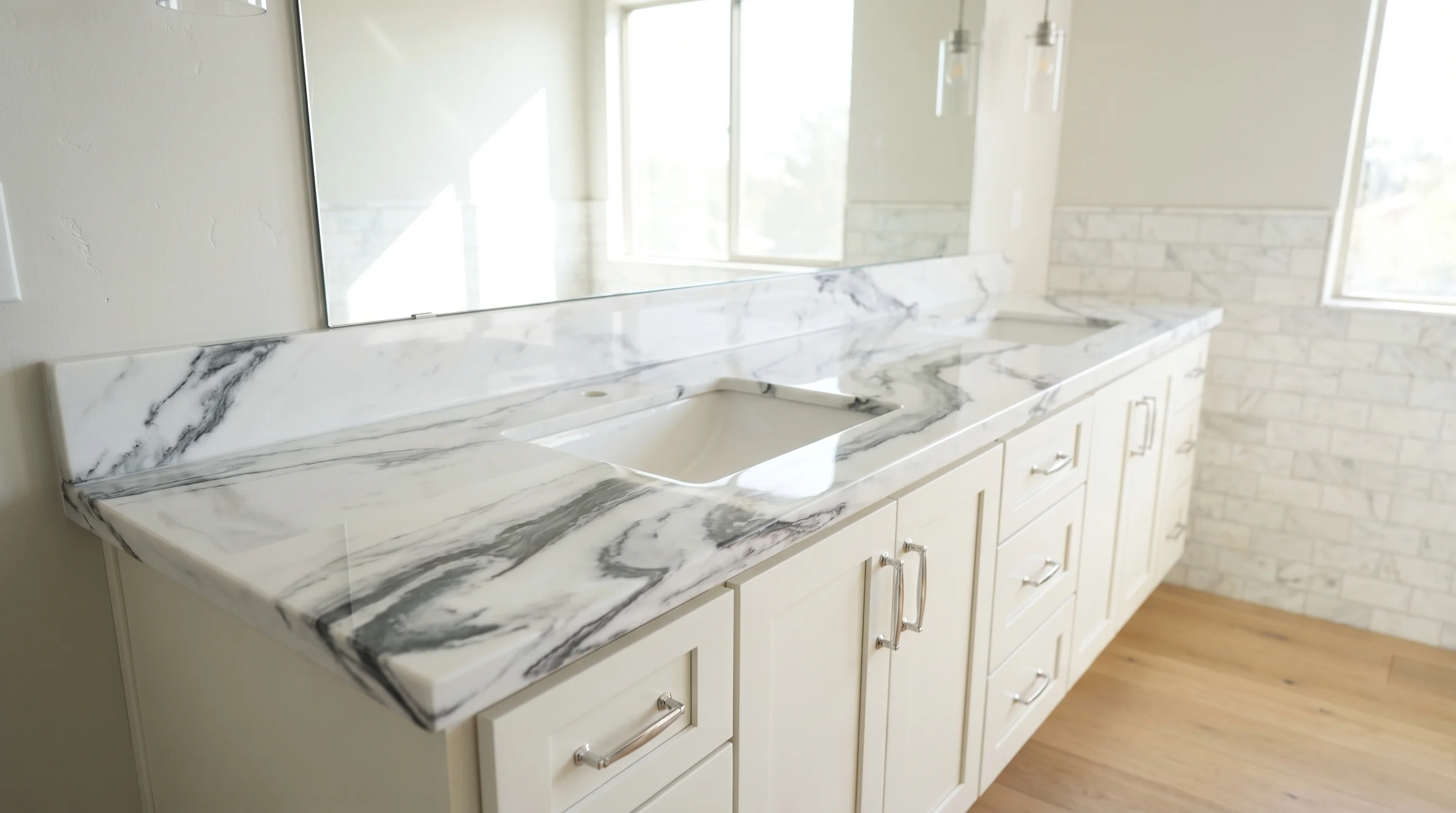
Every look below is a finish we pour, shown on a vanity top. Browse all 39 Phoenix-area looks by city and room.
Where we work
We install across the Phoenix metro, including Phoenix, Scottsdale, Paradise Valley, Arcadia, Biltmore, Tempe, Mesa, Chandler, Gilbert, Queen Creek, Ahwatukee, Glendale, Peoria, Surprise, Sun City, Sun City West, Goodyear, Avondale, Buckeye, Litchfield Park, Verrado, Vistancia, Anthem, New River, Cave Creek, Carefree, Fountain Hills, Apache Junction, Maricopa, Sun Lakes, Eastmark, Las Sendas, Desert Ridge, Moon Valley, McCormick Ranch, Willo Historic, Roosevelt Row, and Wickenburg.
Frequently asked questions
A half bathroom resurface starts at $299 installed, and a full bathroom starts at $499. Each price covers materials, labor and installation in a single day. Replacing a vanity top with a natural stone slab typically costs more, because you are paying material, fabrication minimums, and the plumbing disconnect required to pull the old top and sink.
Phoenix water runs roughly 350 to 500 ppm total dissolved solids. On porous surfaces like marble, limestone, and unsealed granite, calcium deposits etch the finish and leave permanent dull rings, often within months. A non-porous seamless surface gives the minerals nothing to bond into.
Yes. Lab stone is poured over the existing vanity top and we work around a separate drop-in or undermount sink. If you would rather have an integrated look where basin and counter read as one surface, that is also available.
A single vanity is usually finished in well under a day, and multiple bathrooms are commonly completed in one visit. There is no demolition and no multi-week fabrication lead time.
Yes, and it is the most common bathroom we work on. The basin stays plumbed and in place, and the poured surface is carried over the granite and finished at the basin edge. If you would rather have no seam at the basin at all, an integrated basin replaces that joint entirely. Worth noting: searching "undermount sink granite epoxy" mostly returns two-part adhesive for gluing a sink to a slab, which is a different product from a poured lab stone surface.
That is the simplest version. The basin is not fixed into the surface, so it is lifted off, the full slab is resurfaced edge to edge with no cut-out to work around, and the basin is reset. The area directly under the basin is usually where a Phoenix granite vanity shows the heaviest mineral staining, because water pools there and evaporates, so it is the part that benefits most.
Price your Phoenix bathroom
Pick your layout and sink type, choose a finish, and get an instant estimate. No sales call required.
Configure & Price My Vanity Call (602) 507-2683